Rangewell · 2026
Naming the Ache: Launching Menopause Care Through Employers
Rangewell, a digital clinic for joint and muscle care, launches Menopause Care to members through their employers. A concept campaign I directed end to end, from the brand and a measured-joint callout system to emails, direct mail, an employer kit, a landing page, paid social, app onboarding and a welcome kit, plus the system, test plan and team model behind it.
- Concept brand
- Rangewell
- Role
- Concept, Creative Direction & Design
- Year
- 2026
- Disciplines
- Integrated Campaign, B2B2C Growth, Brand System, AI-Assisted Production
The Brief
Digital joint and muscle care already helps millions of people, but few women connect their stiff mornings and sore knees to menopause. I set a growth brief for a program sold through employers: get eligible women to check their coverage, enroll and finish a first session, with the employer as the door and privacy as the promise.
The Insight
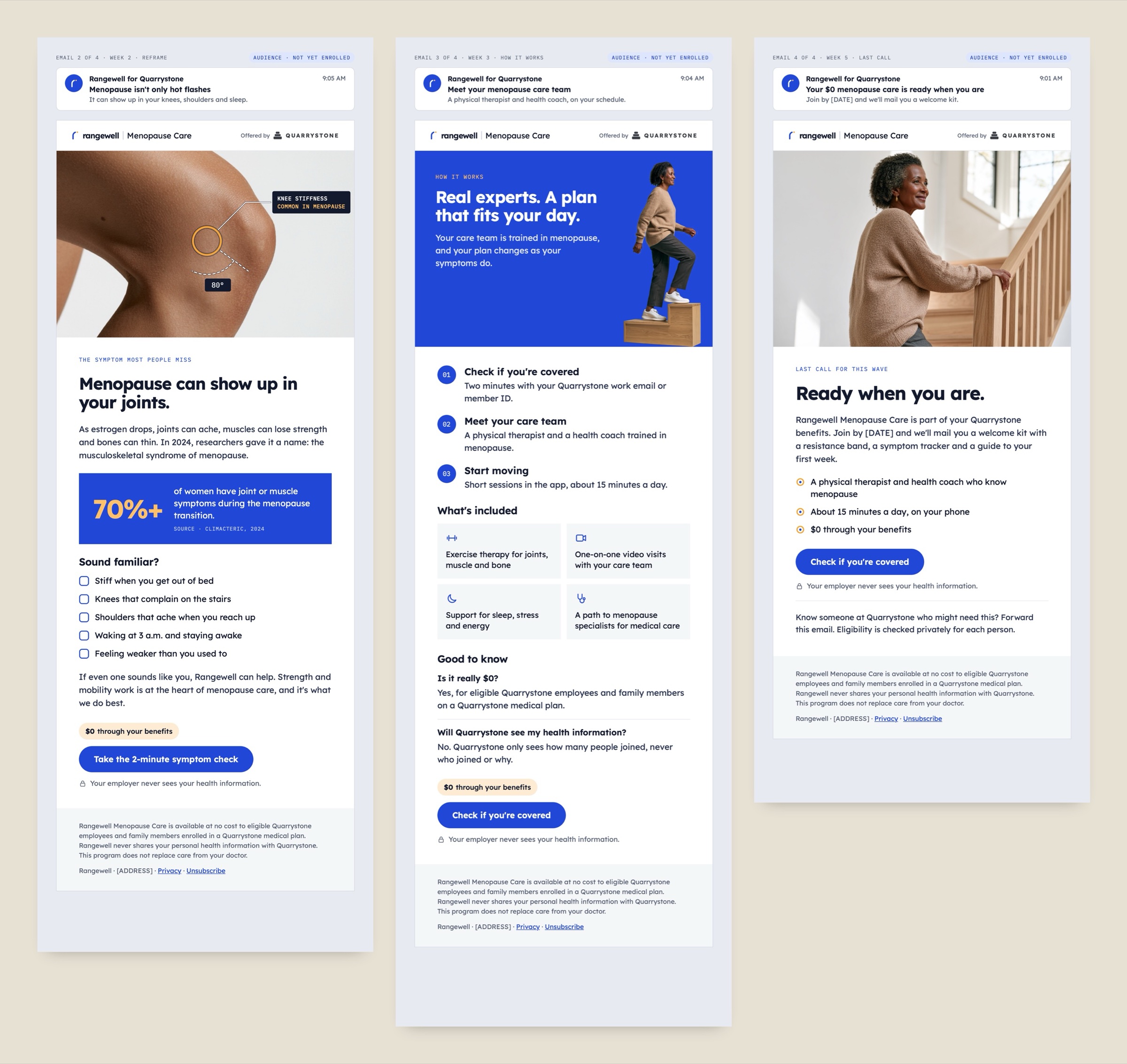
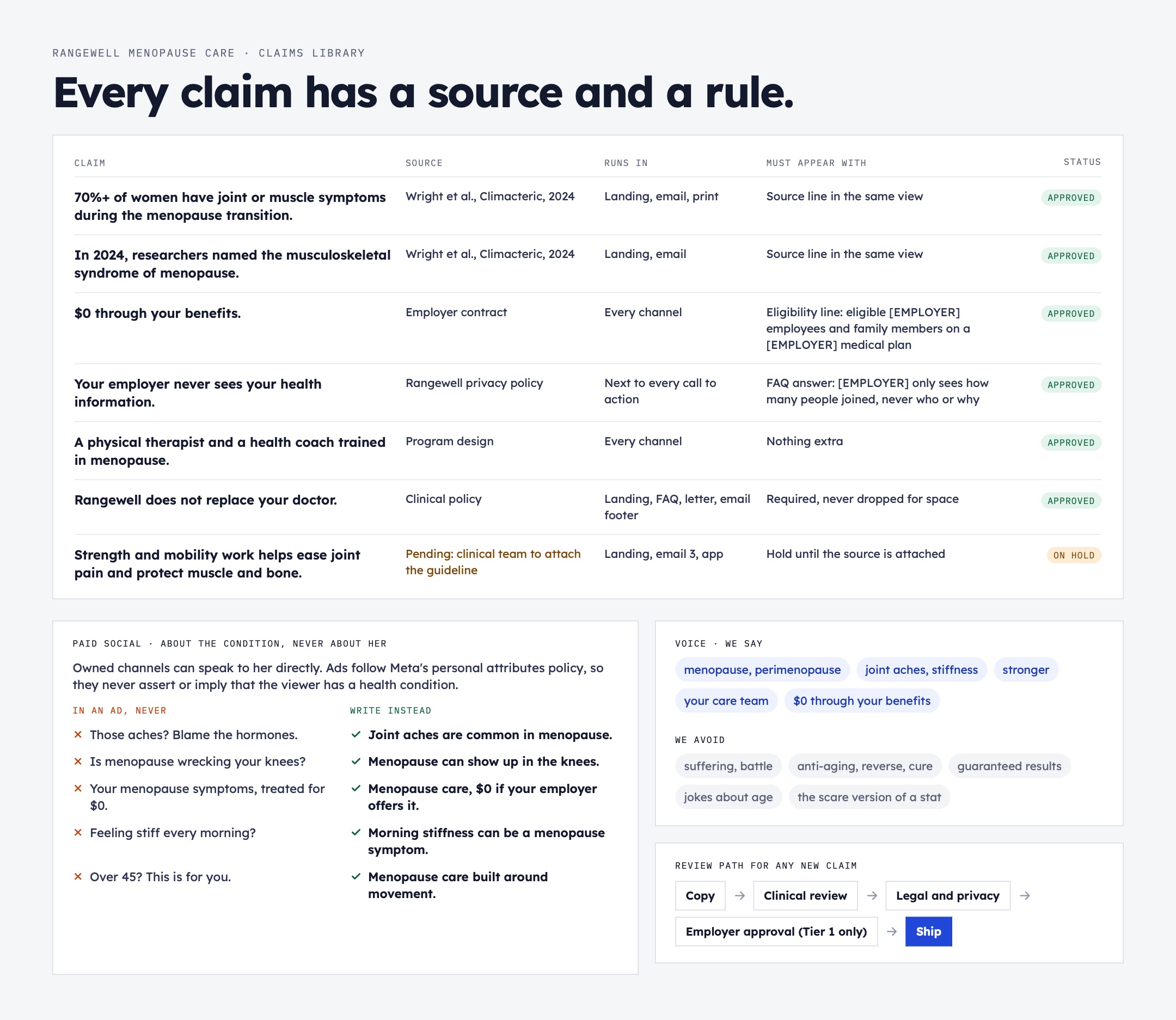
In 2024, researchers named the musculoskeletal syndrome of menopause, and more than 70% of women have joint or muscle symptoms during the transition (Wright et al., Climacteric, 2024). Most women blame their age. The campaign names the real cause.
The Approach
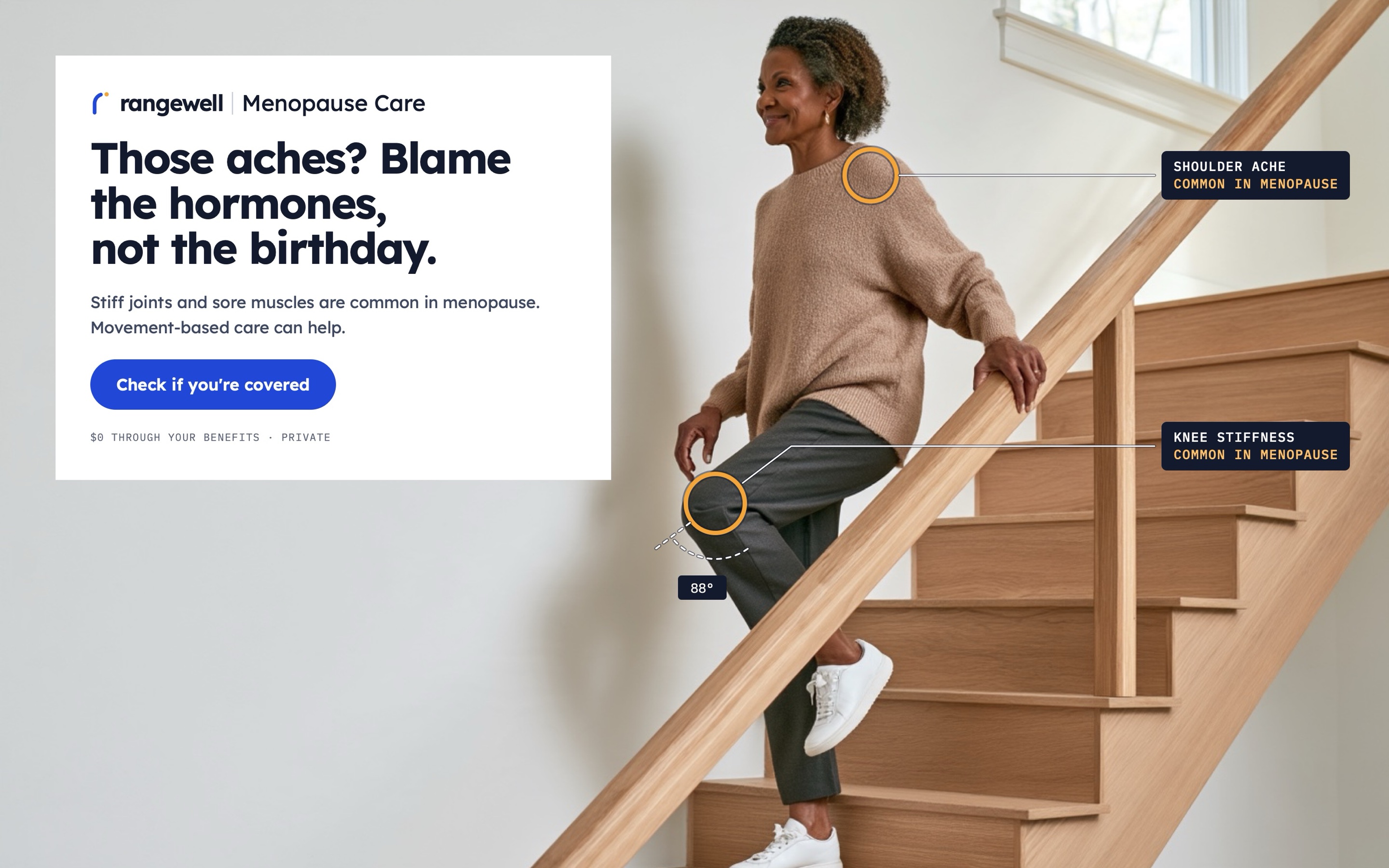
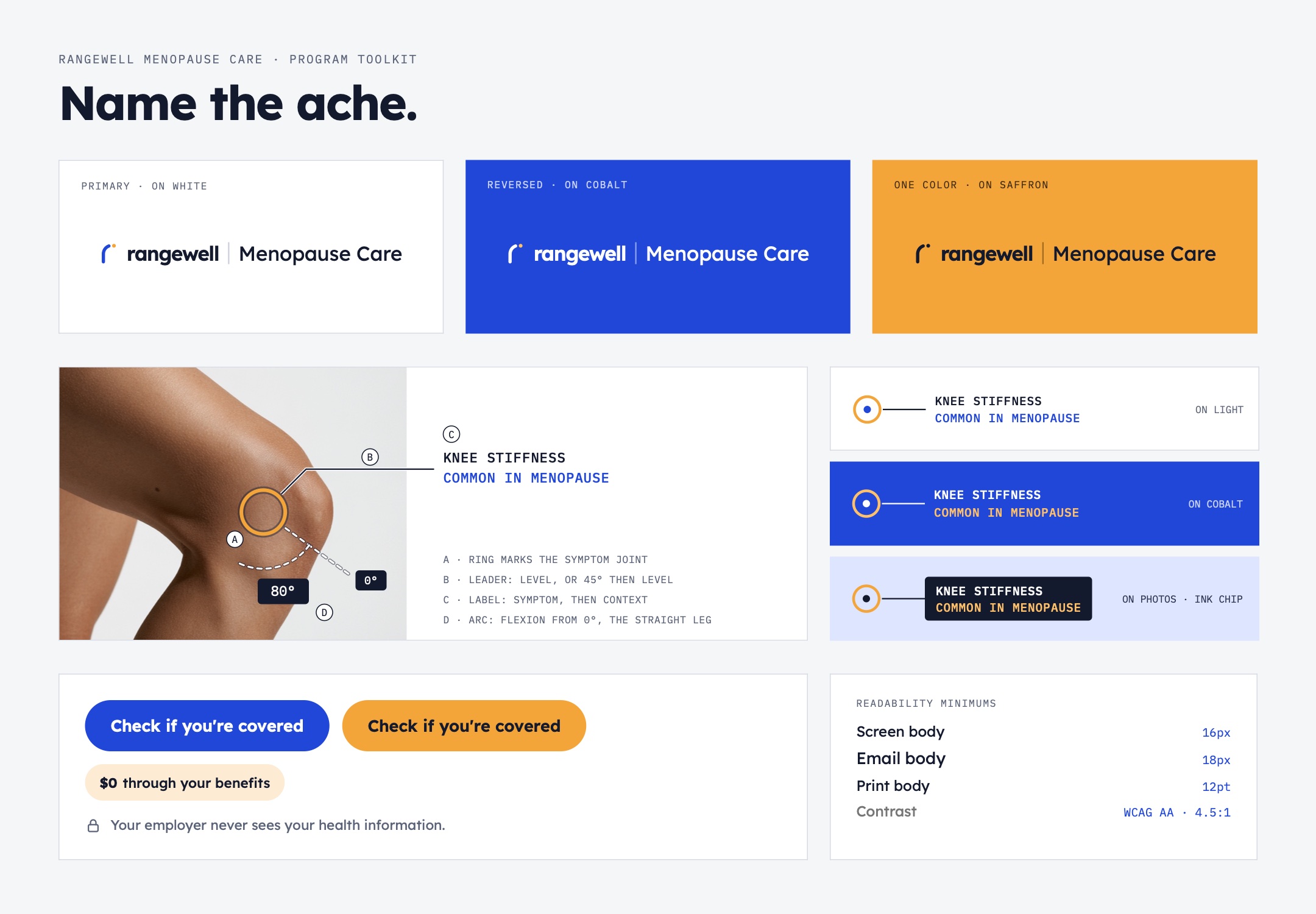
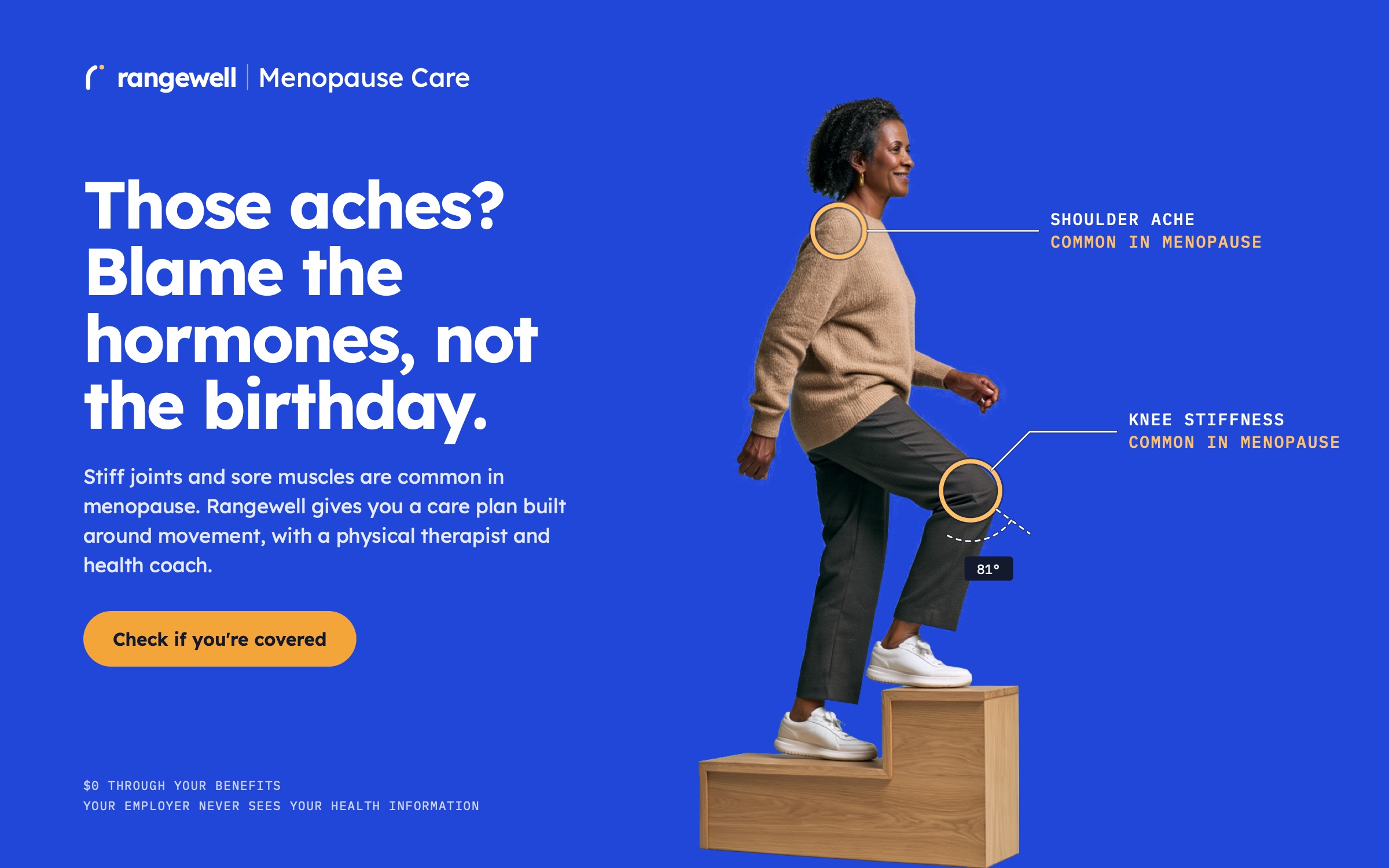
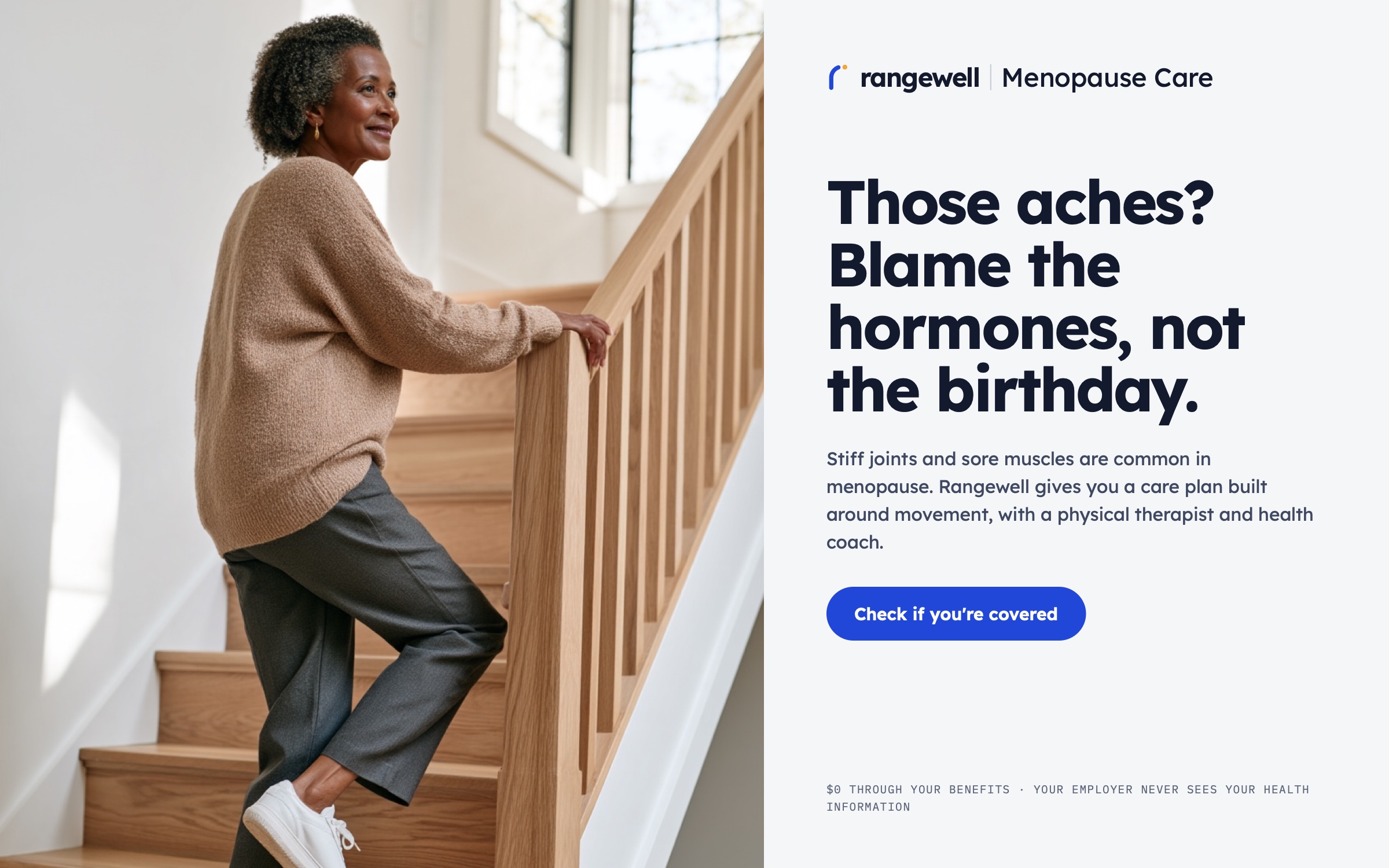
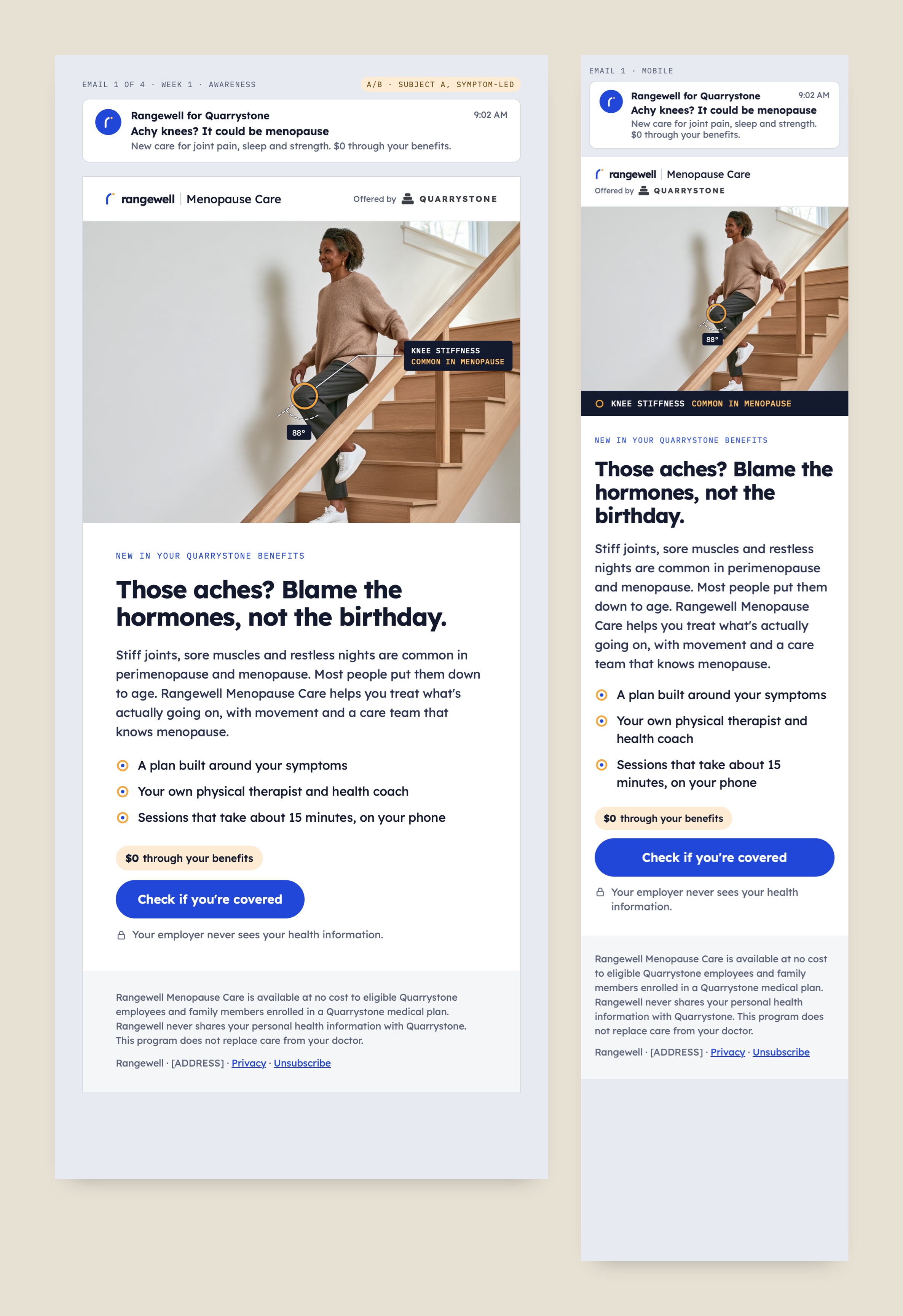
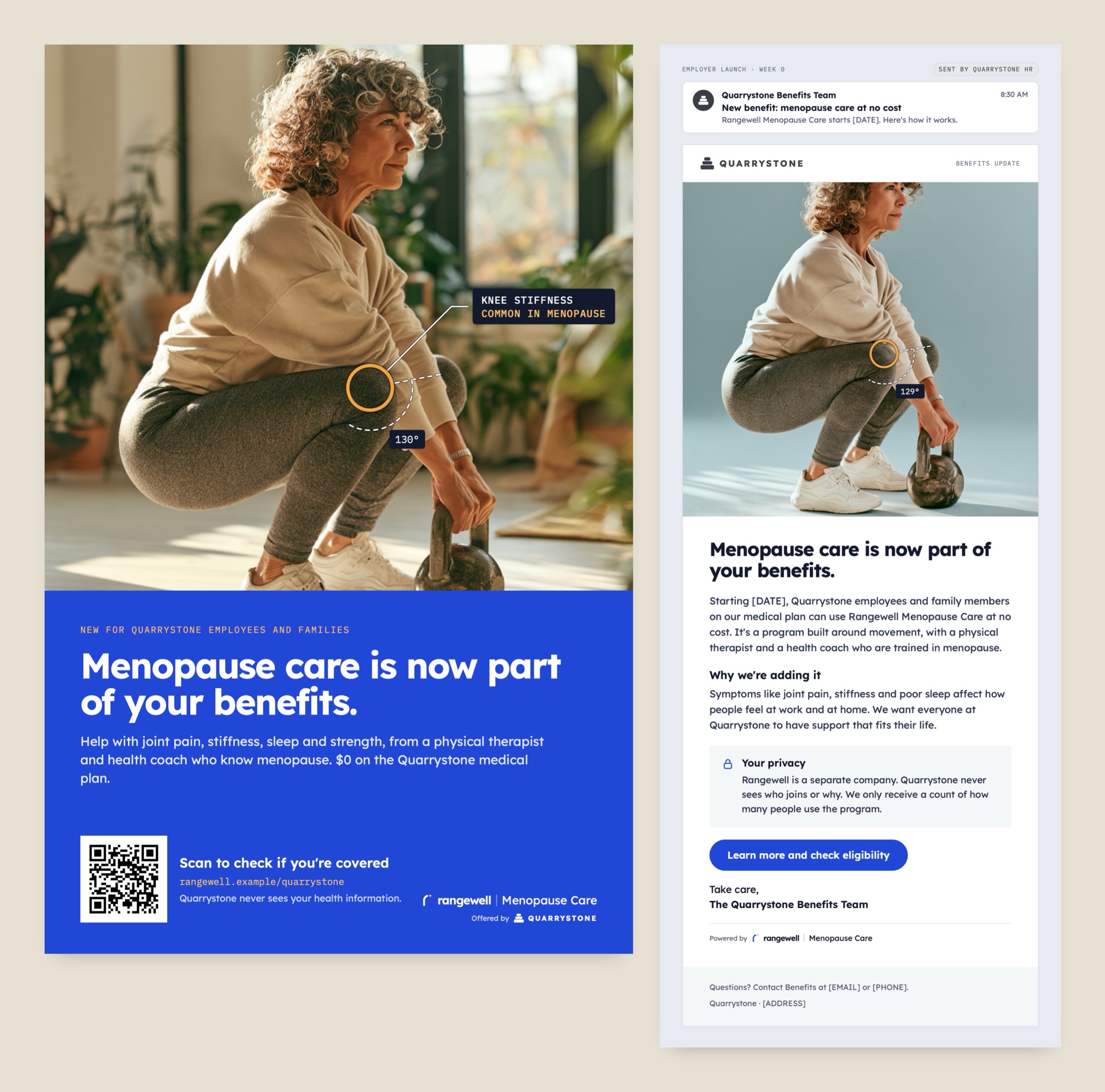
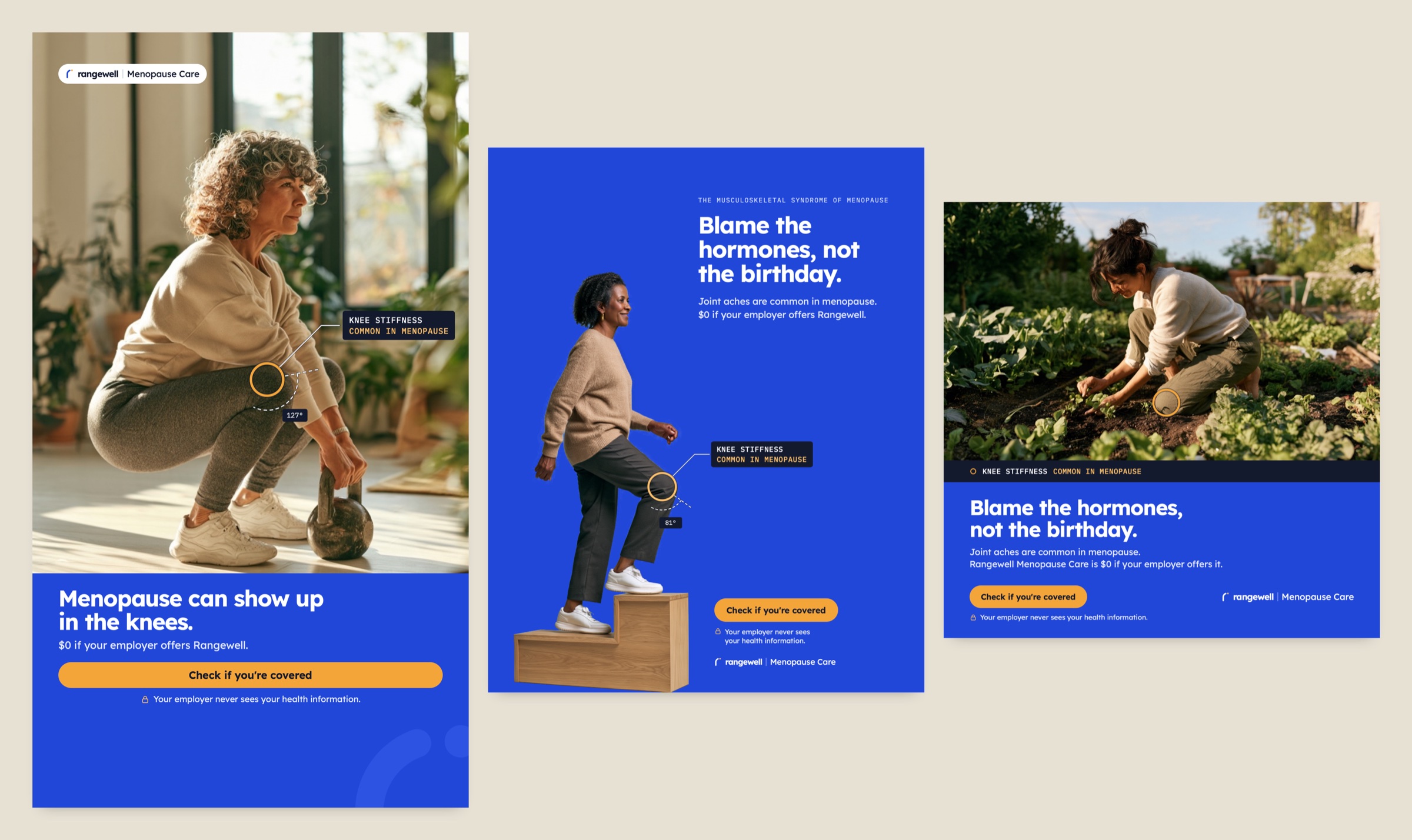
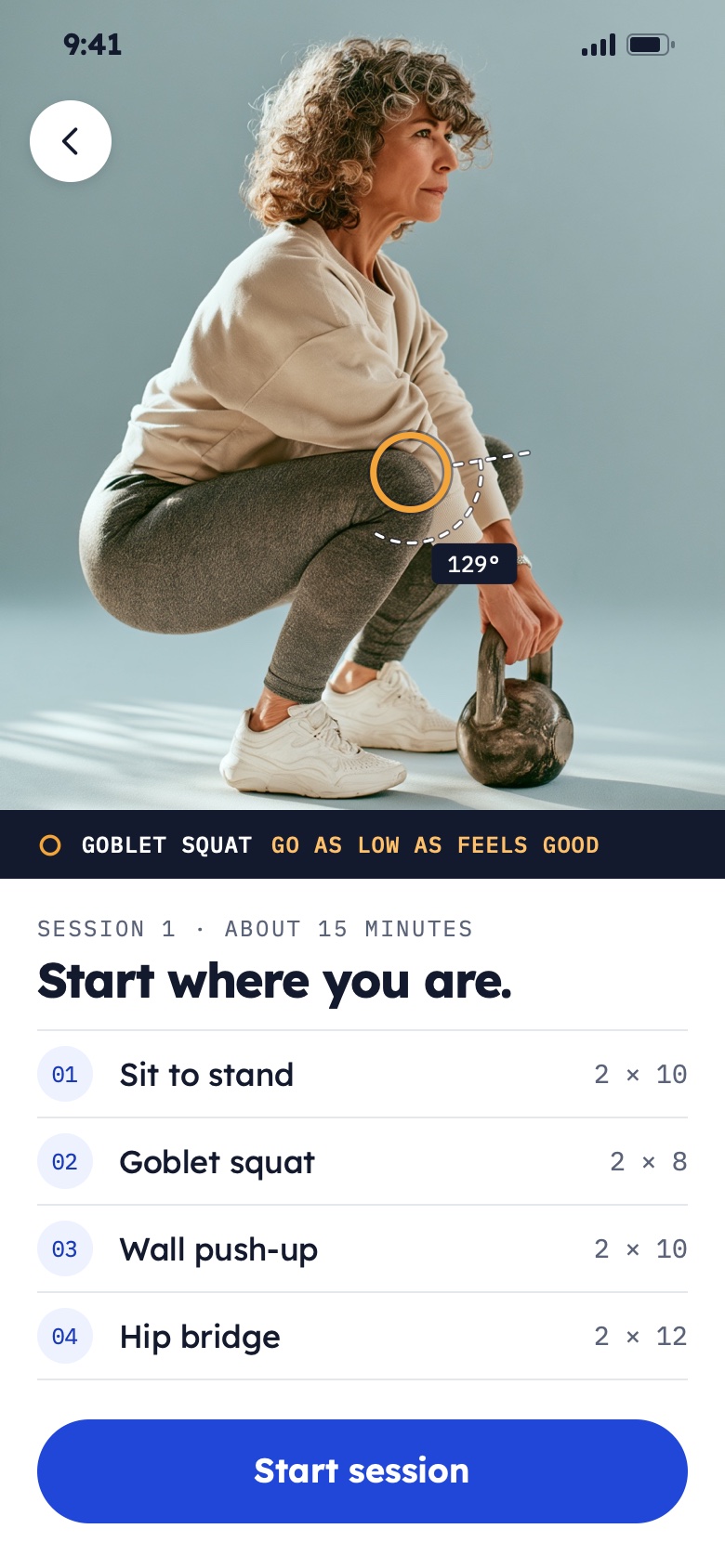
One line, “Those aches? Blame the hormones, not the birthday,” and one device to prove it: a saffron ring on the joint, a dotted line for the straight leg and an arc that shows the real bend in degrees, measured from each photo. Three trust devices travel with every piece: $0 through your benefits, a privacy line next to every call to action, and mail that never says menopause on the outside.
What It Builds On
The work draws on real projects: workplace retirement enrollment materials for employers and employees at Vanguard, and educational pieces explaining complex health programs for Aetna at MOD Worldwide.
Identity & Key Visual
Brand Identity · Art Direction · AI Photography Direction
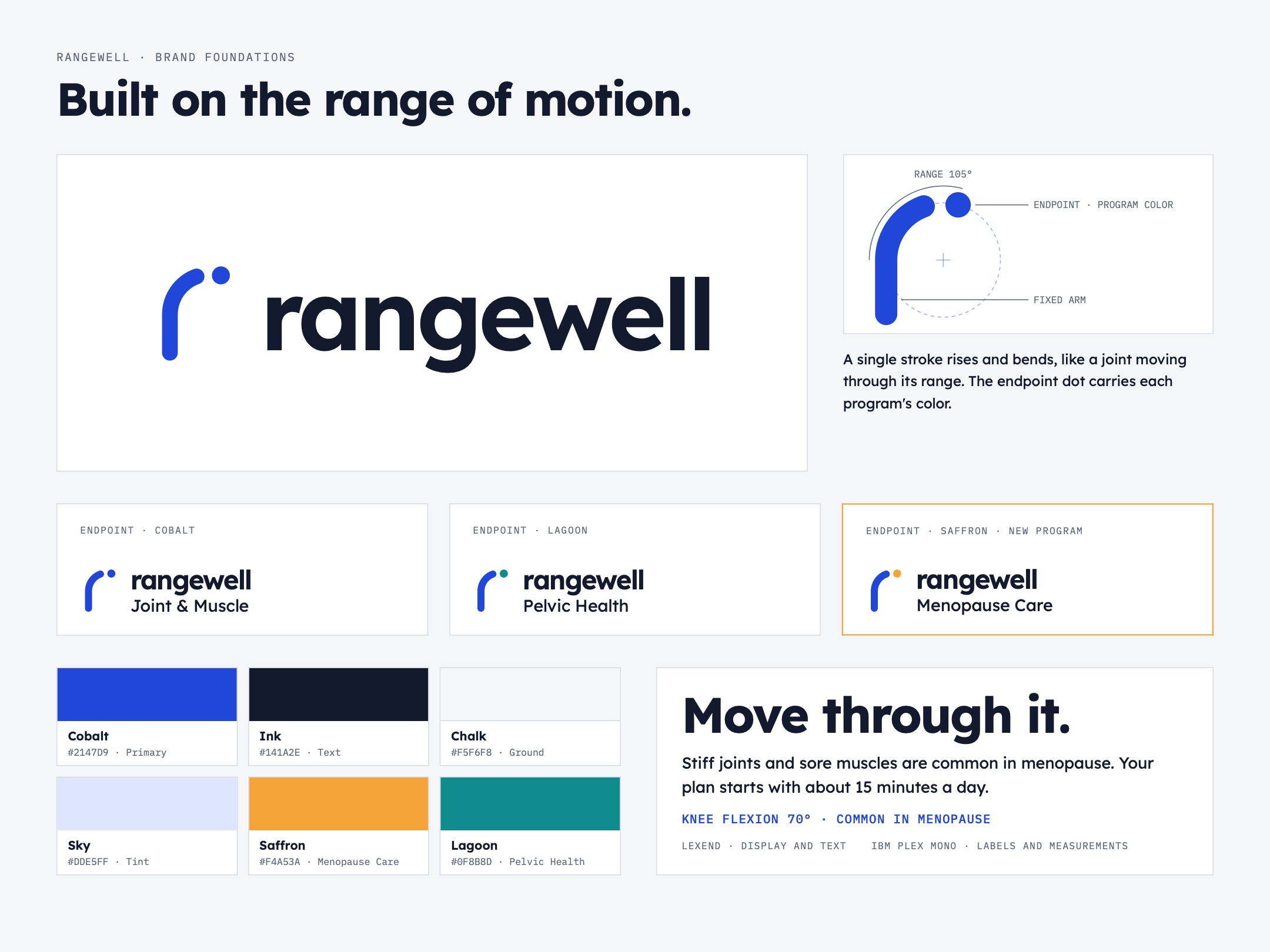
Rangewell had to read as clinical and warm at once. I paired a cobalt base with a saffron program color, Lexend for readability and IBM Plex Mono for every measurement. The mark is a single lowercase r stroke whose end dot takes each program’s color, so Menopause Care sits inside a larger family.
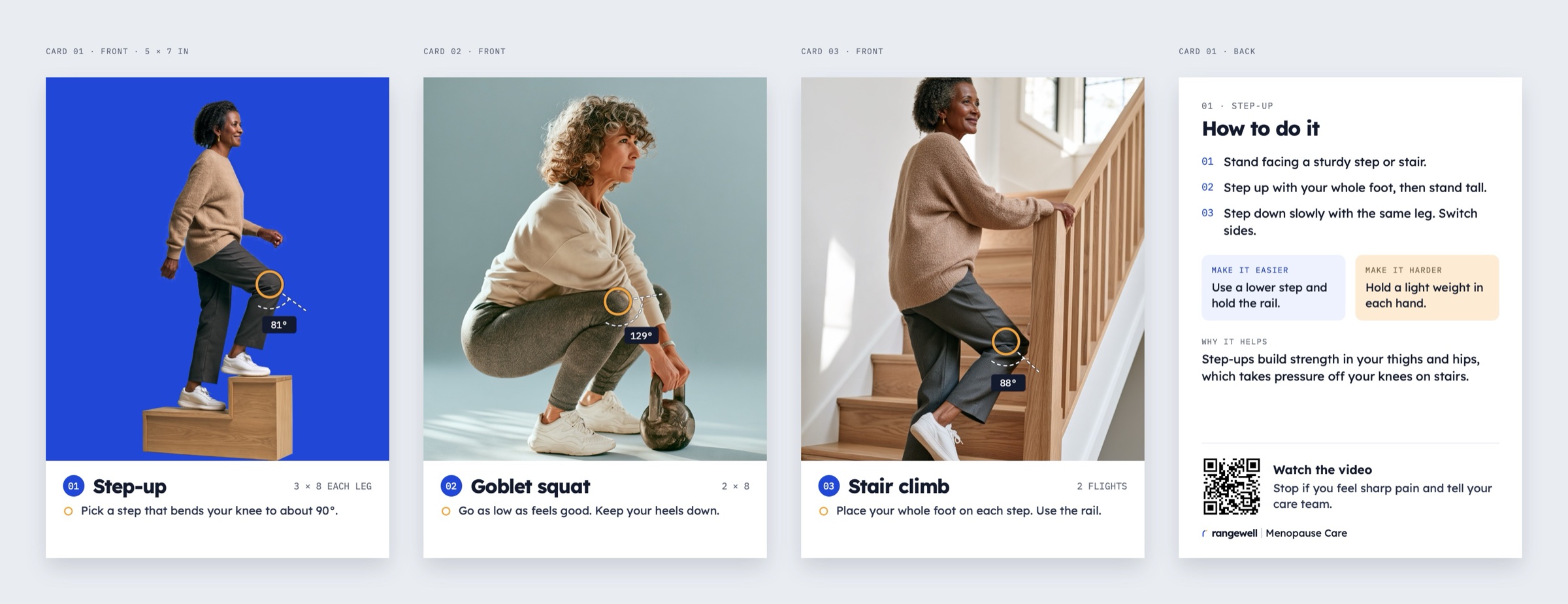
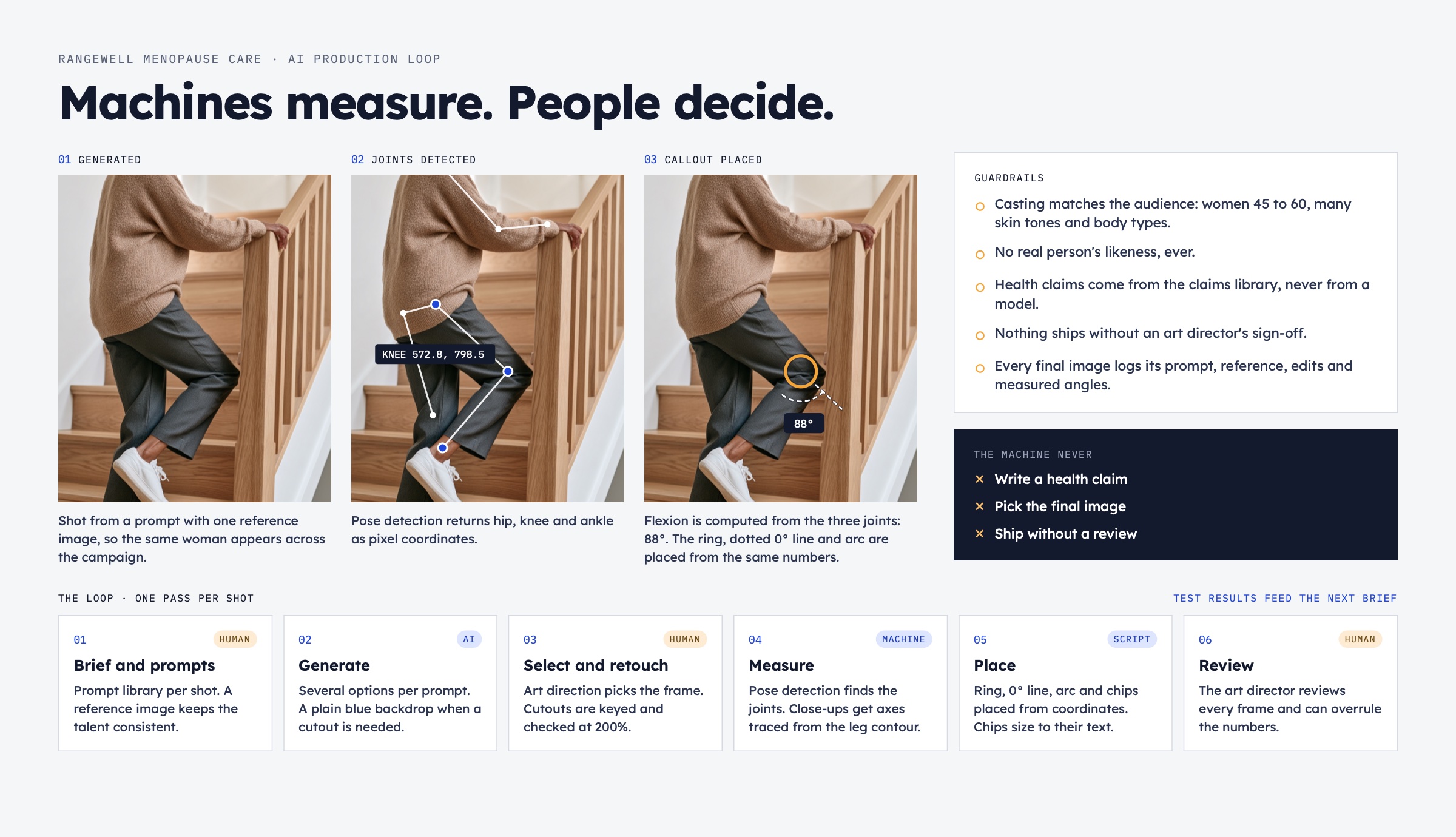
Every photo is AI-generated from prompts I directed, with a reference image per model to keep the same women consistent from shot to shot. The callouts are not drawn by eye. Pose detection finds the hip, knee and ankle, and the arc shows the real angle: 81° on the step-up, 88° on the stairs.
Member Journey & Email
Lifecycle Strategy · Email Design
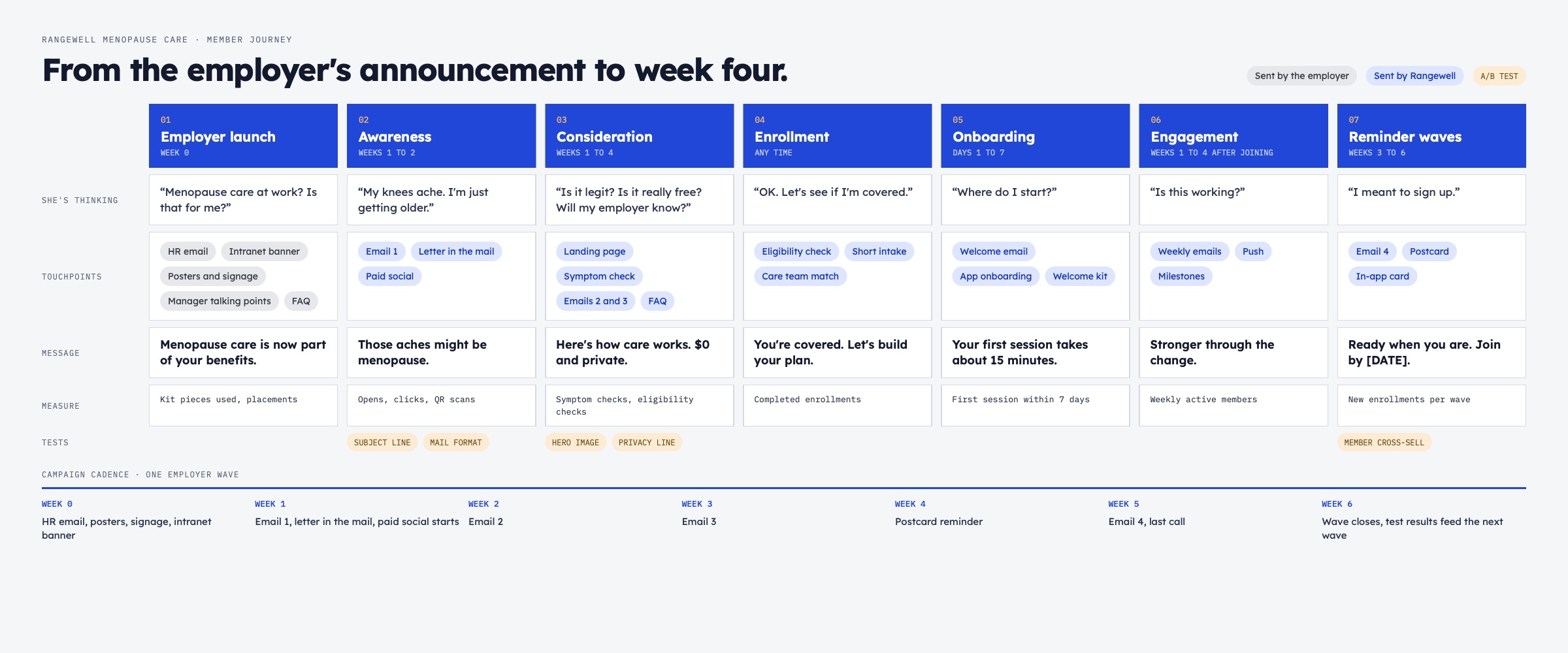
The journey runs seven stages, from the employer’s launch to week four of the program, with what she is thinking, the touchpoint, the message, the metric and the test at each step.
Four emails move her from awareness to last call: name the ache, reframe it, show how care works, then a deadline. Each is built at 720 px with a mobile version, the privacy line next to the button and the $0 badge in view.
Direct Mail & Employer Kit
Print · Direct Mail · Employer Marketing
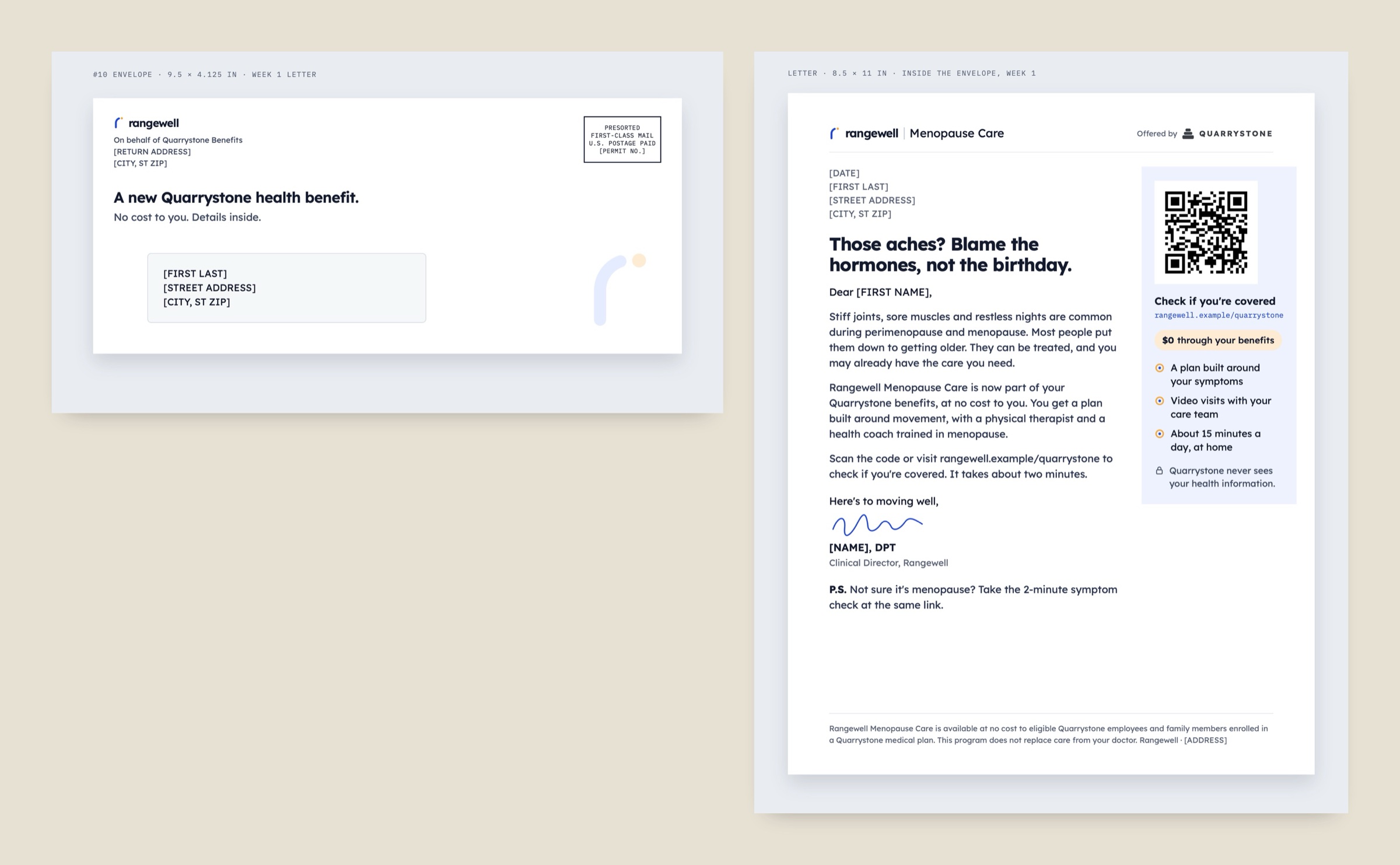
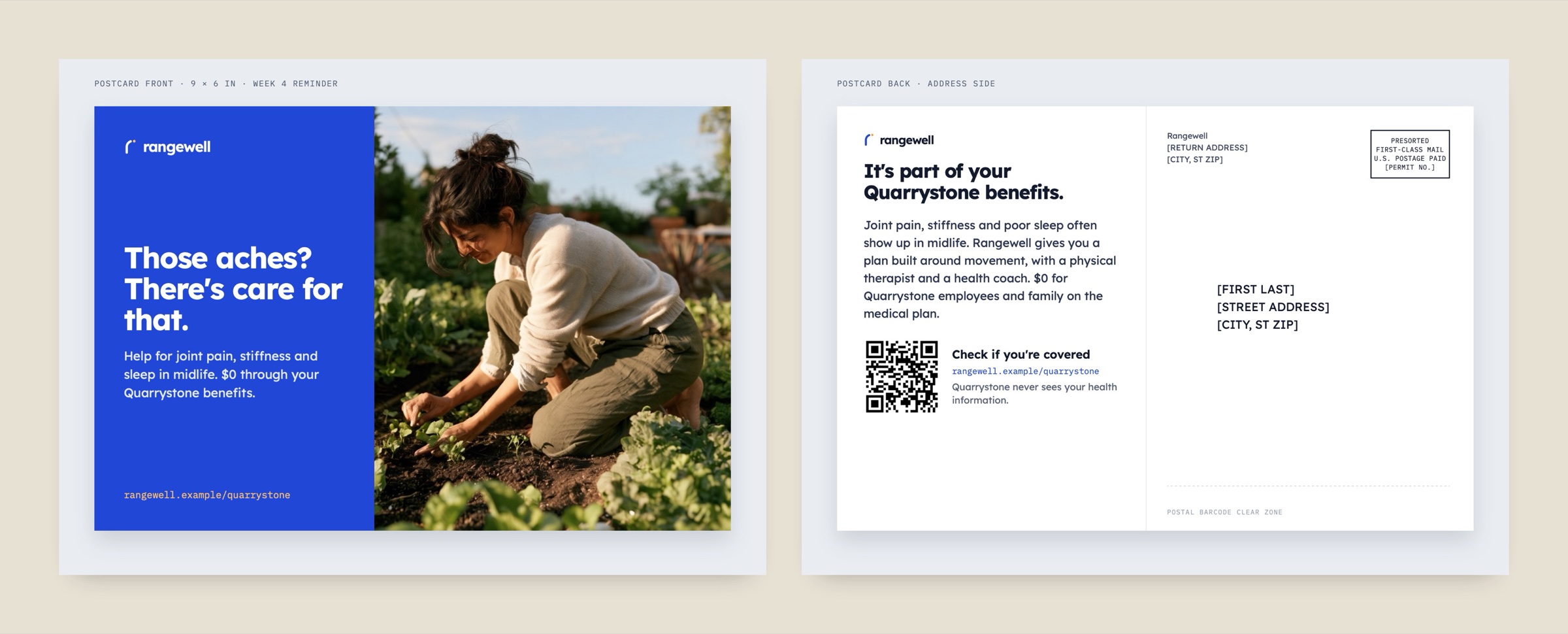
Mail lands where anyone in the household can see it, so the envelope and the postcard’s address side never mention menopause. The letter and the card front reveal the program inside, with a QR code for each test cell.
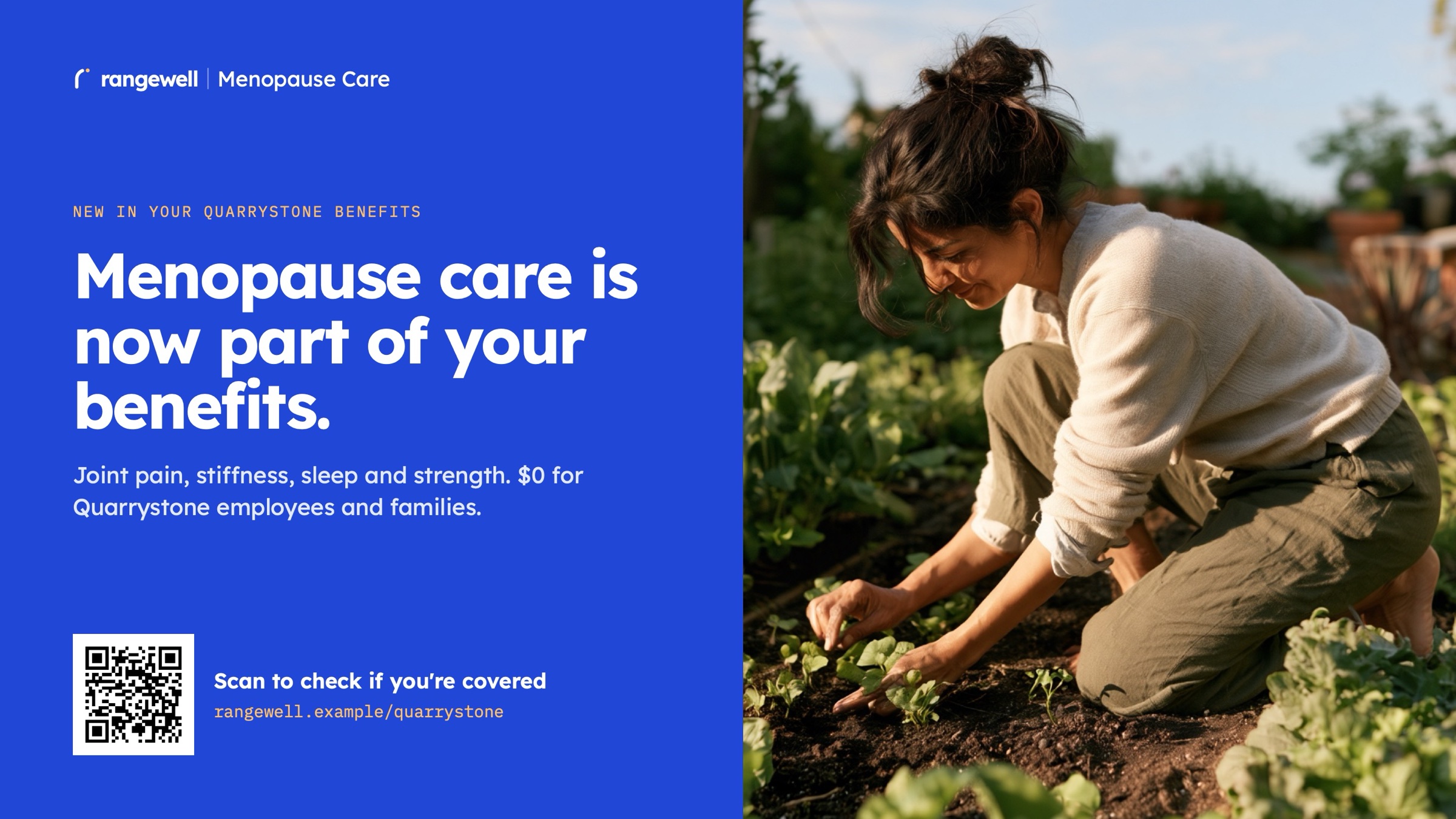
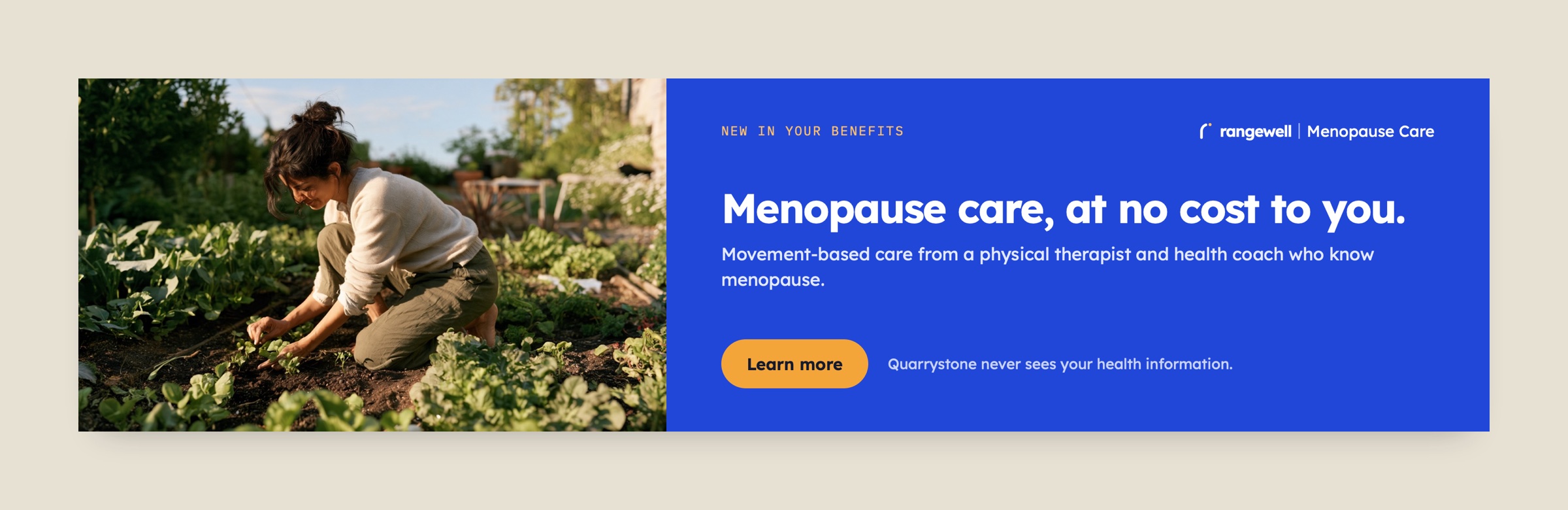
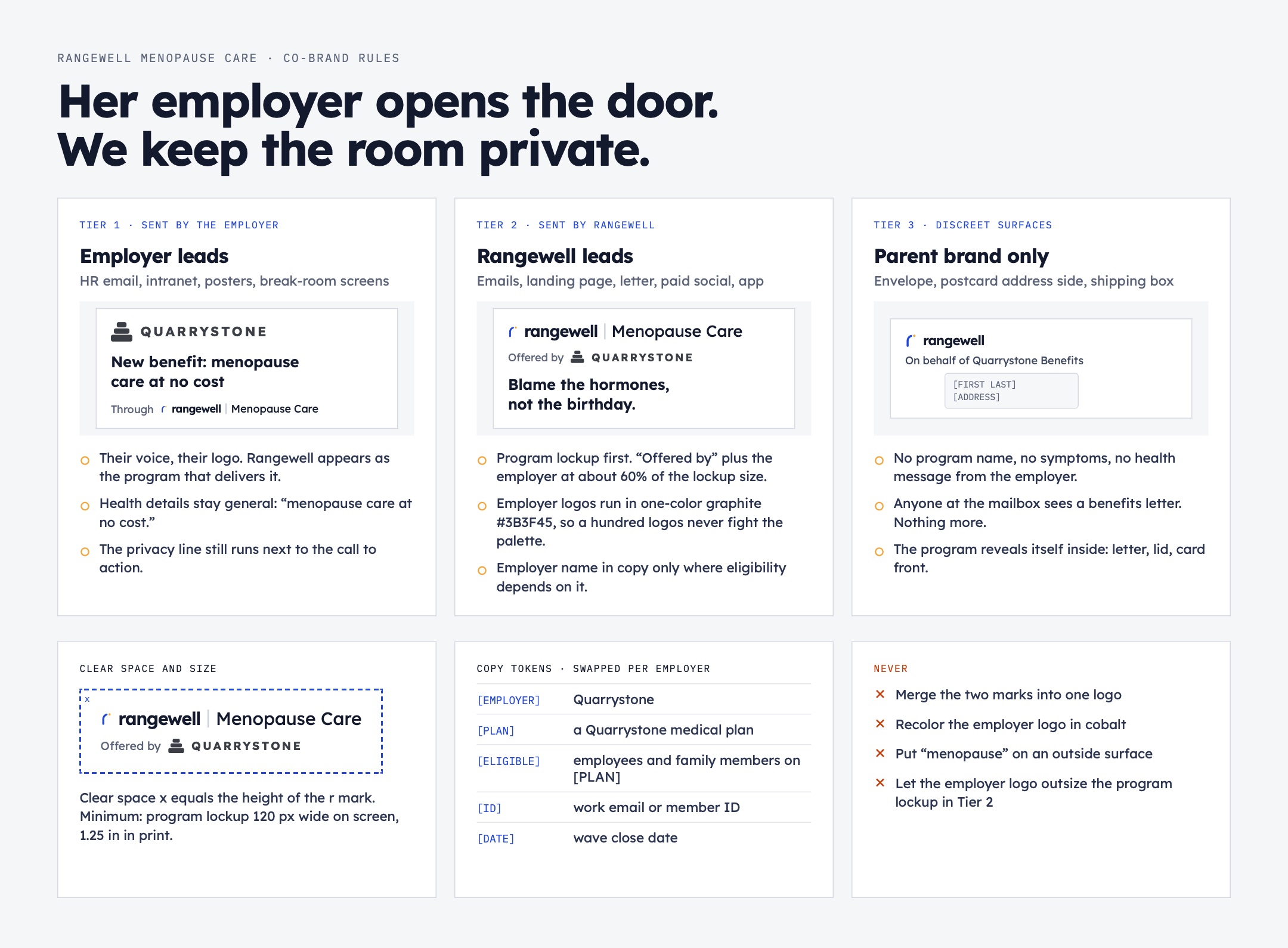
Employers announce the benefit in their own voice. The kit gives HR a poster, a break-room screen, an intranet banner and an announcement email, co-branded with the employer leading.
Landing Page
Web Design · Conversion Design
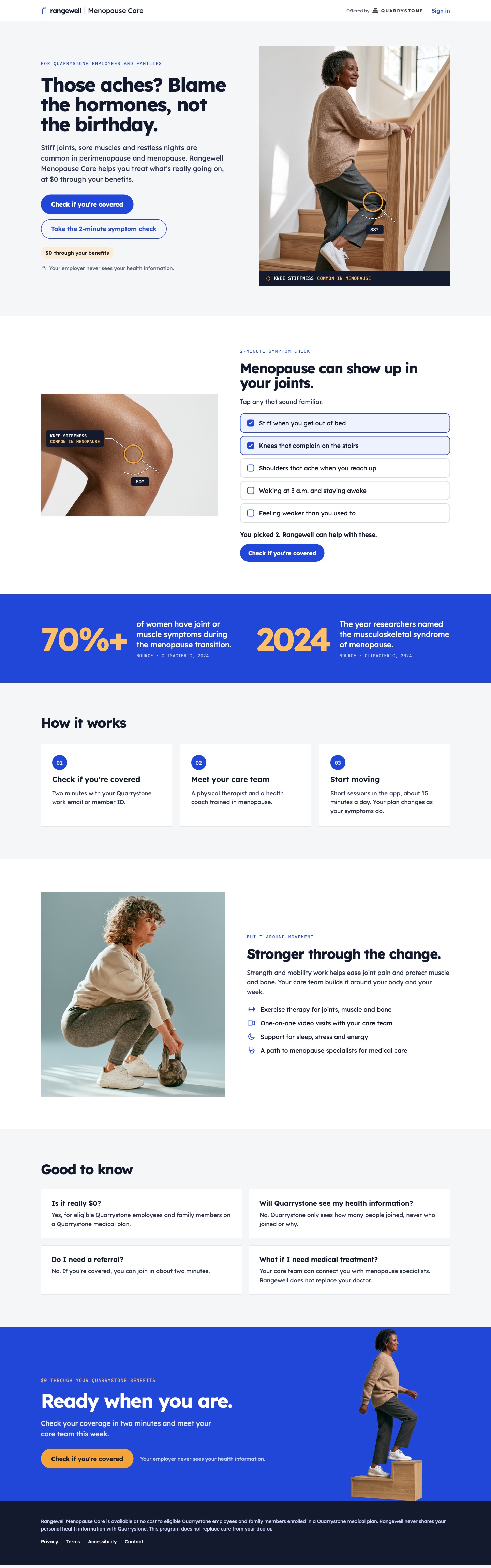
The landing page opens on the campaign line and turns recognition into action with a two-minute symptom check. Every stat carries its source, and the FAQ answers the two questions that stop people: is it really $0, and will my employer see my health information.

Enrollment
Product Design · UX Writing
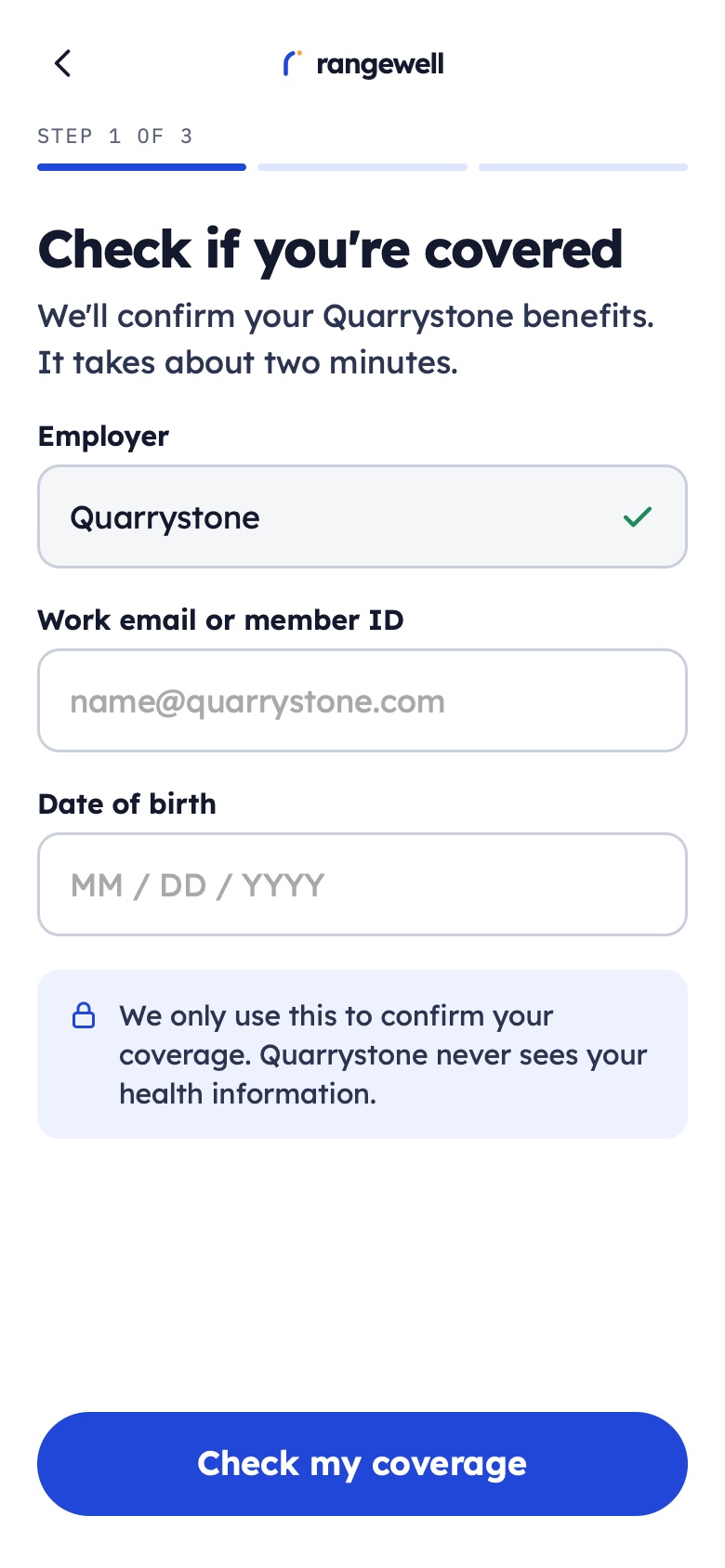
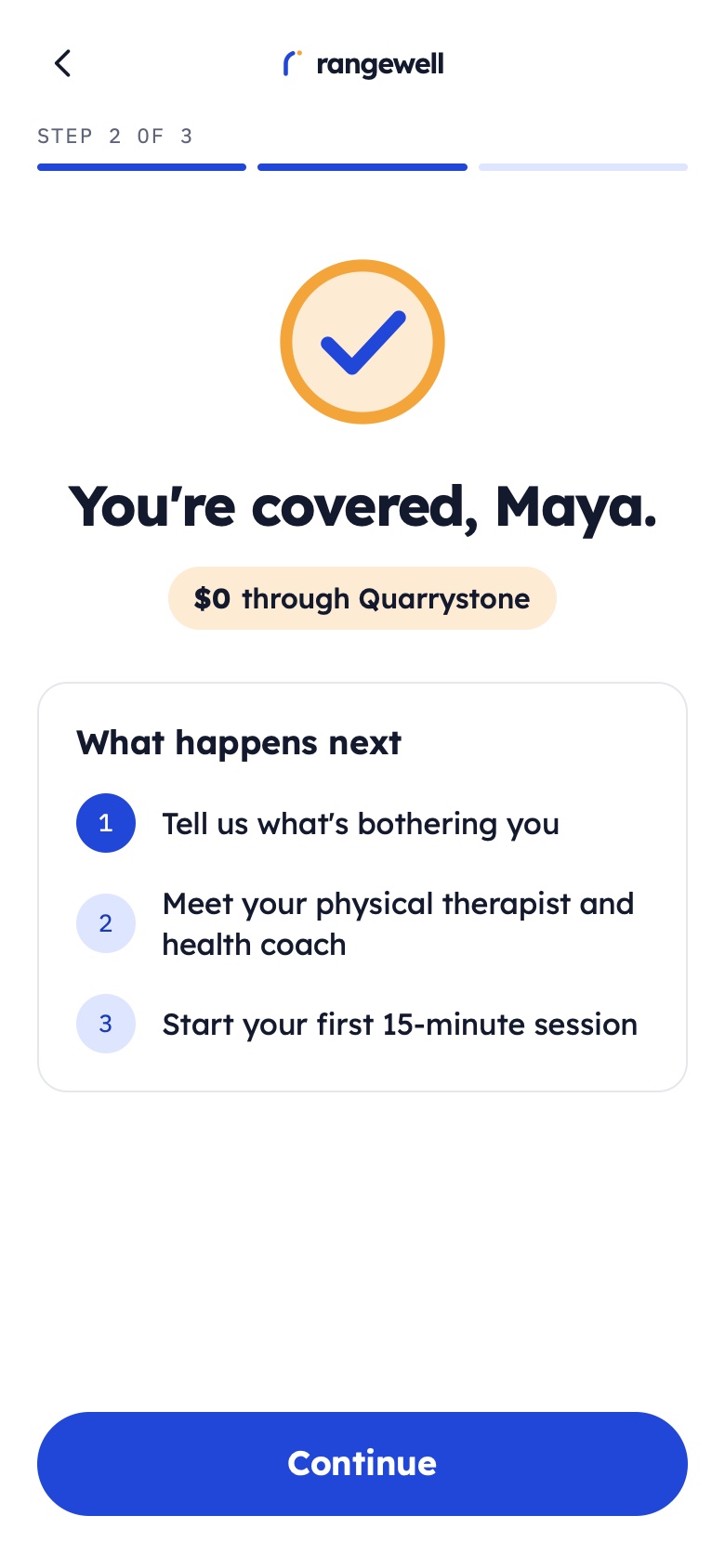
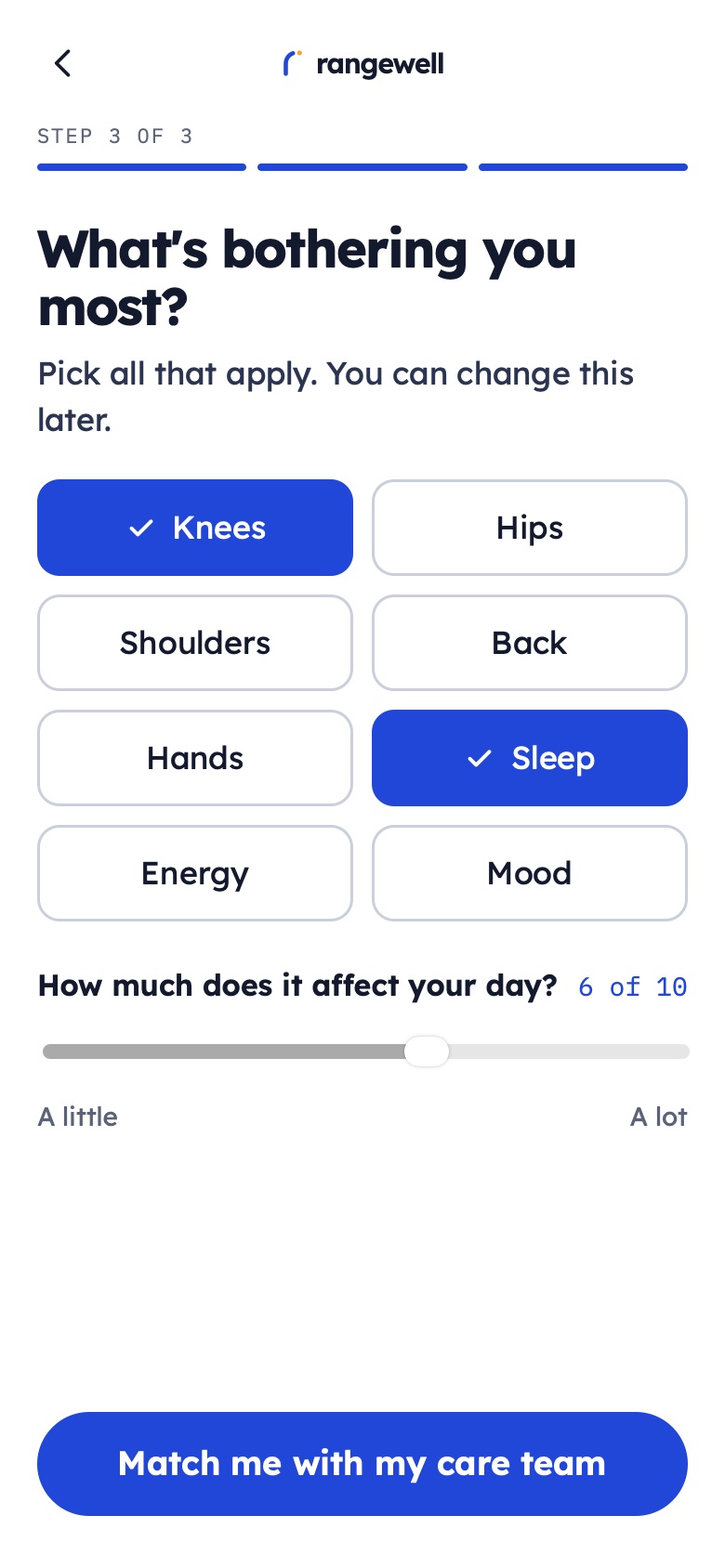
Three screens, each with one job. Check coverage with a work email or member ID, see a clear “You’re covered” moment with the $0 confirmed, then pick what’s bothering you most so the care team match starts before the first visit.
Paid Social
Performance Creative · Art Direction
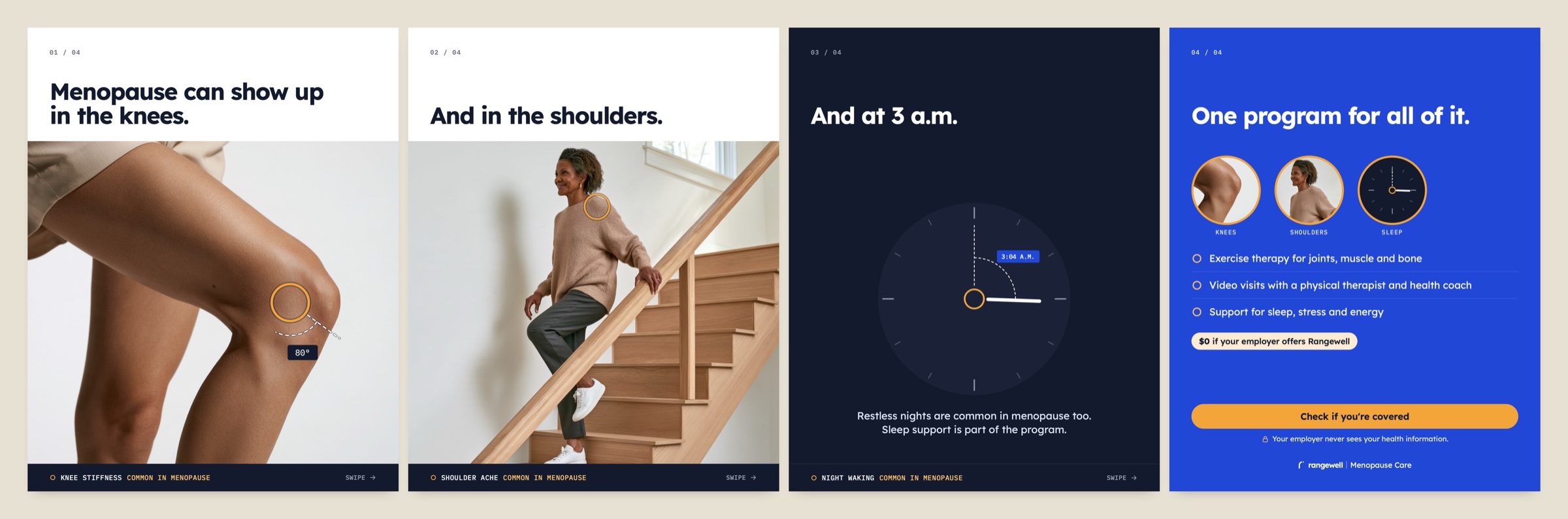
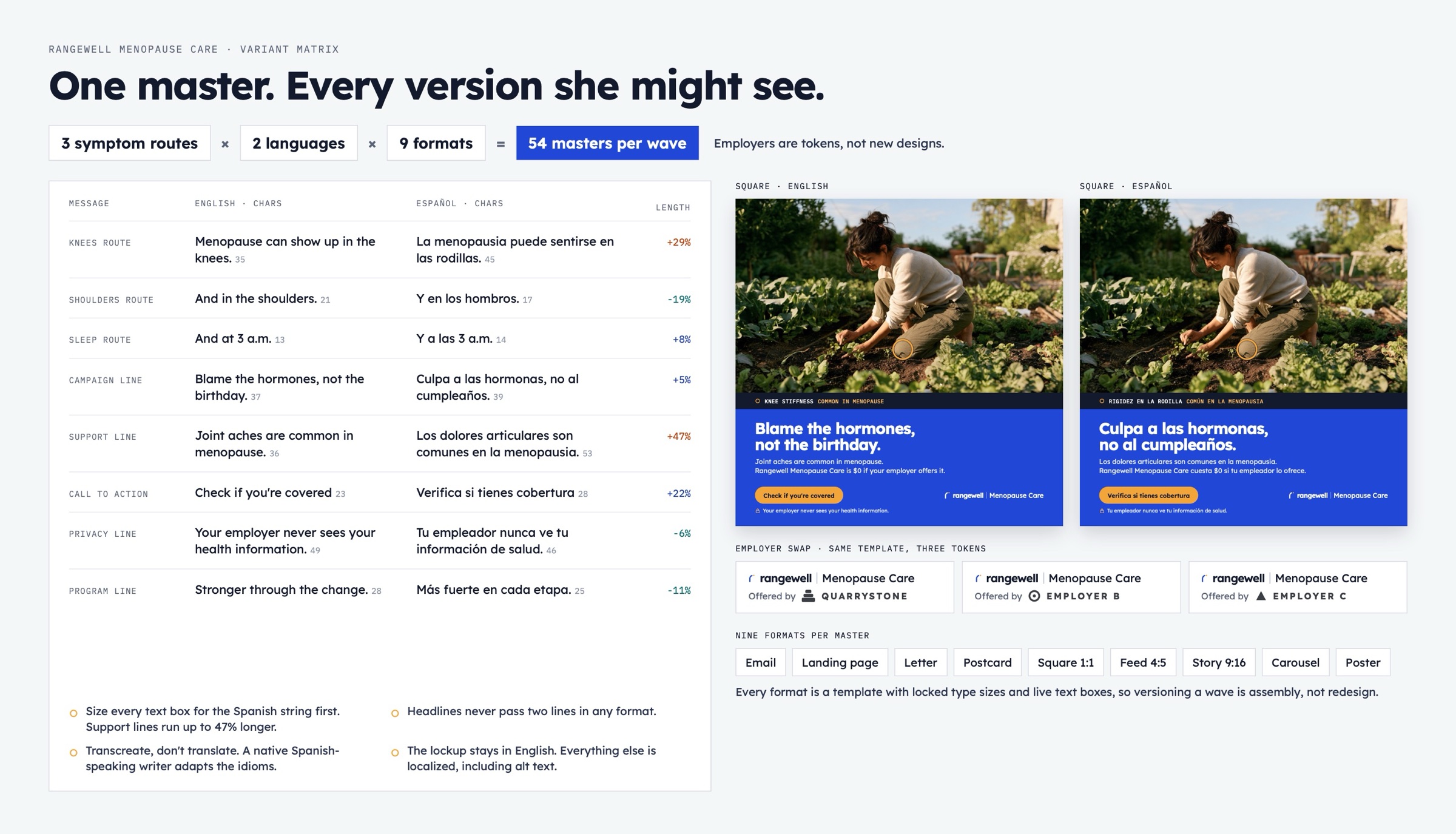
Ads speak about the condition, never about her. Meta’s personal attributes policy rules out lines like “Those aches?” in paid placements, so the ads say “Joint aches are common in menopause” and “Menopause can show up in the knees.” The story keeps every word out of the top and bottom 250 px.
The carousel walks the body: knees, shoulders, then 3 a.m., where the angle callout becomes a clock, and it ends on one program for all of it.
App Onboarding
Product Design · UI
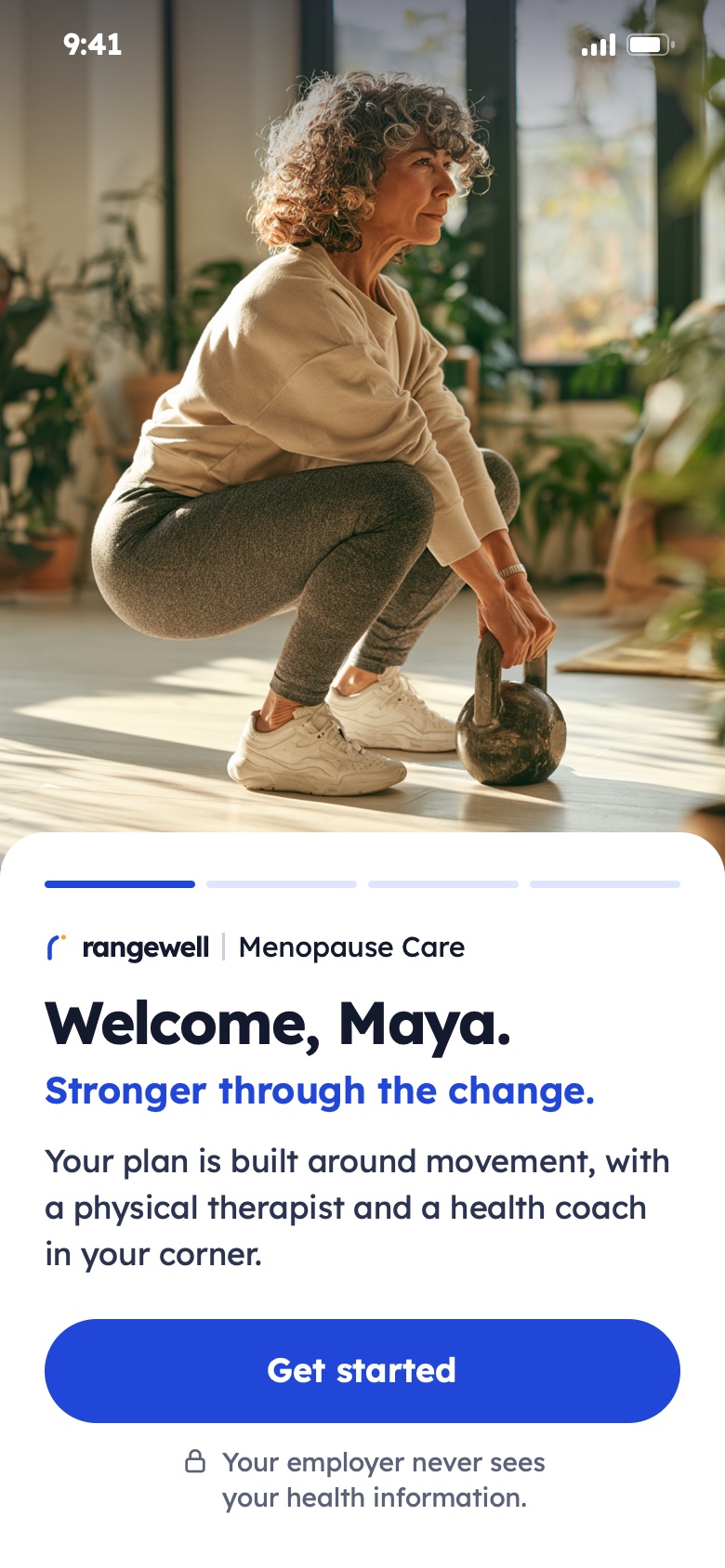
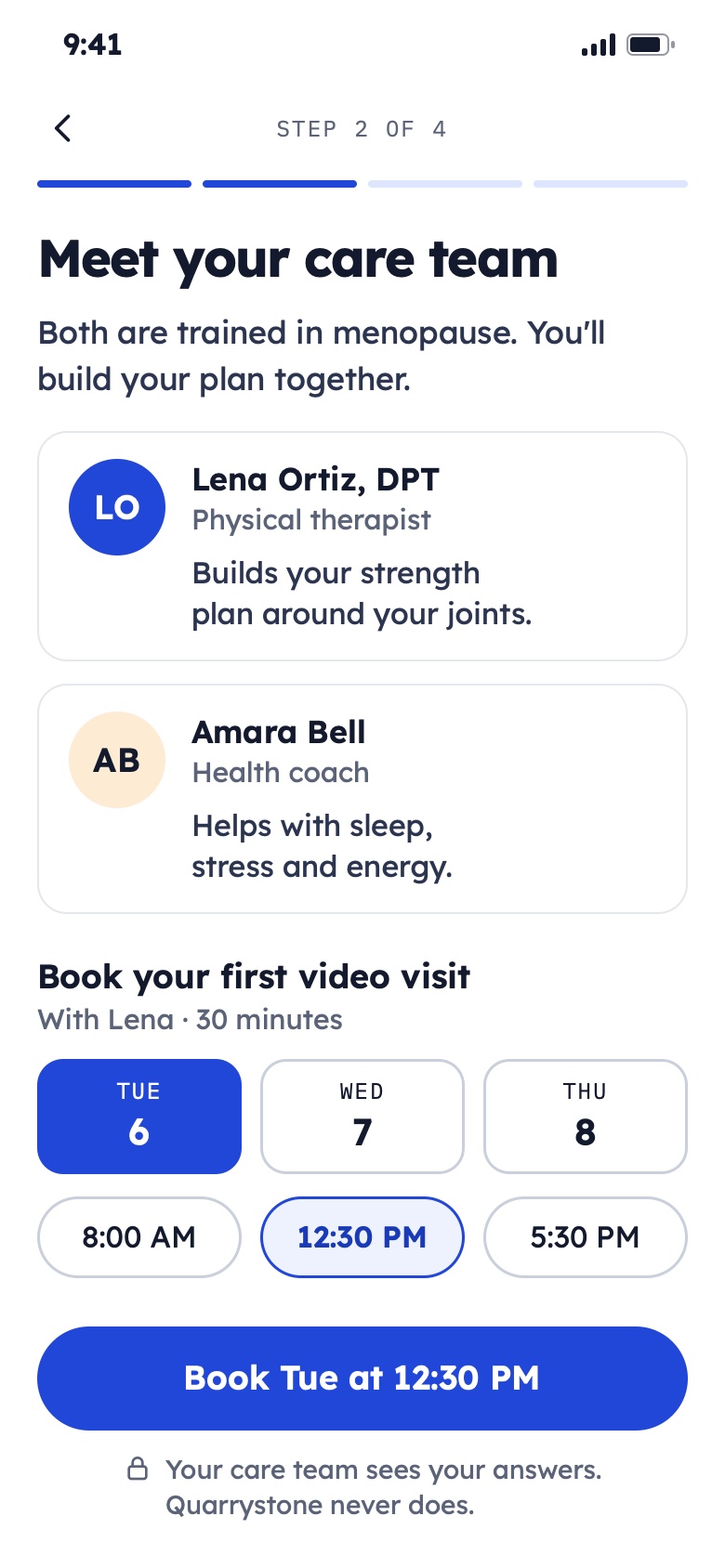
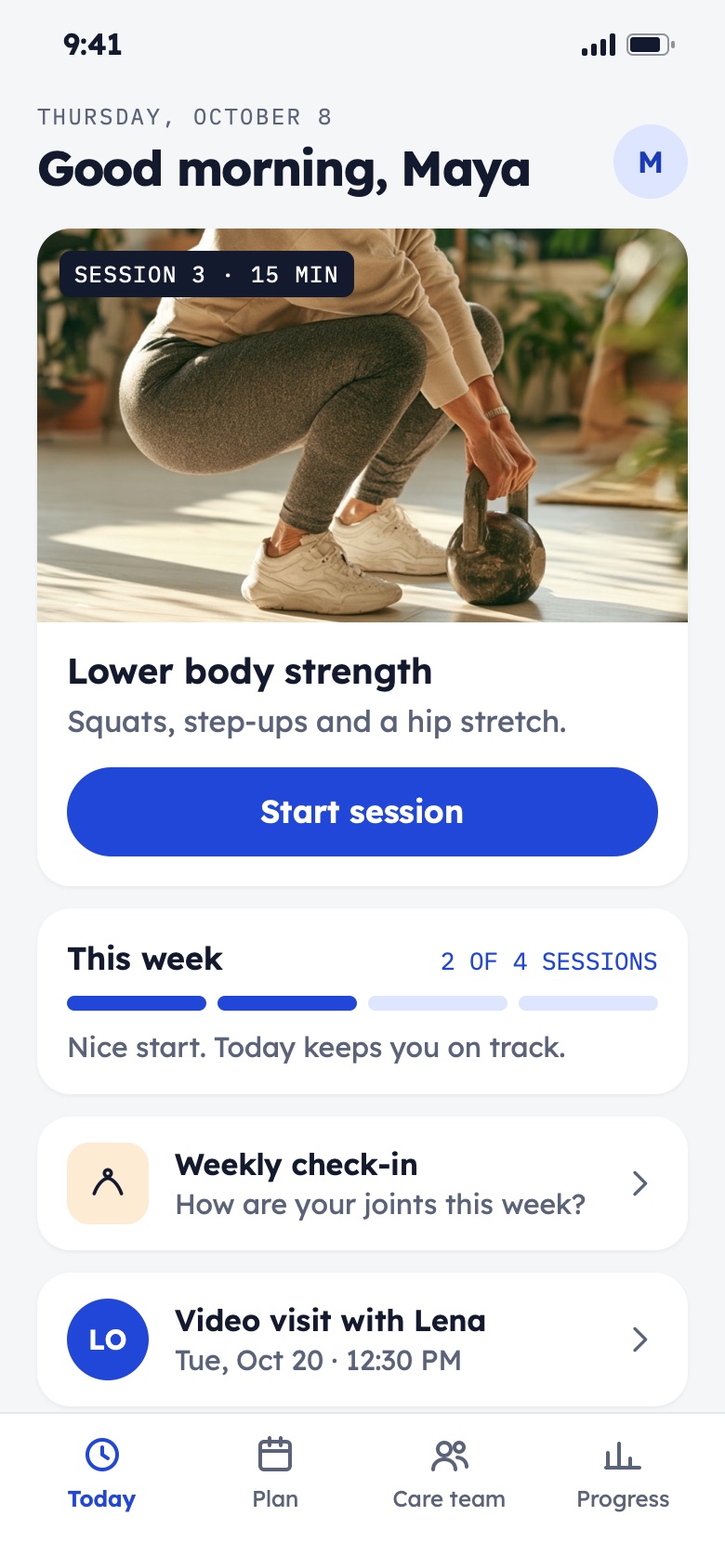
Inside the app the voice shifts to the second route, “Stronger through the change.” Onboarding introduces the care team, books the first video visit and opens the first session with the same callout coaching the squat at 129°. Home keeps the week’s progress, the next visit and the weekly check-in in one place.
Welcome Kit
Packaging · Print · Variable Data
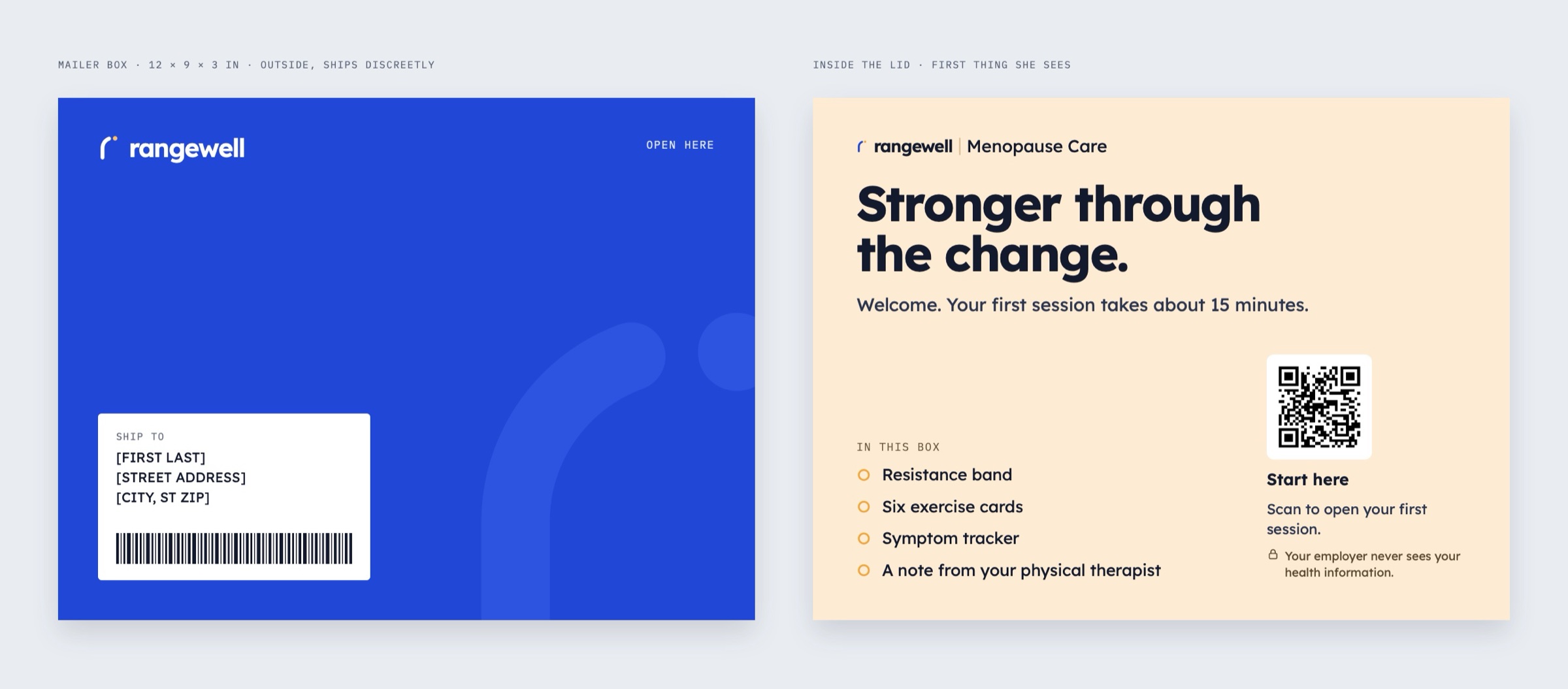
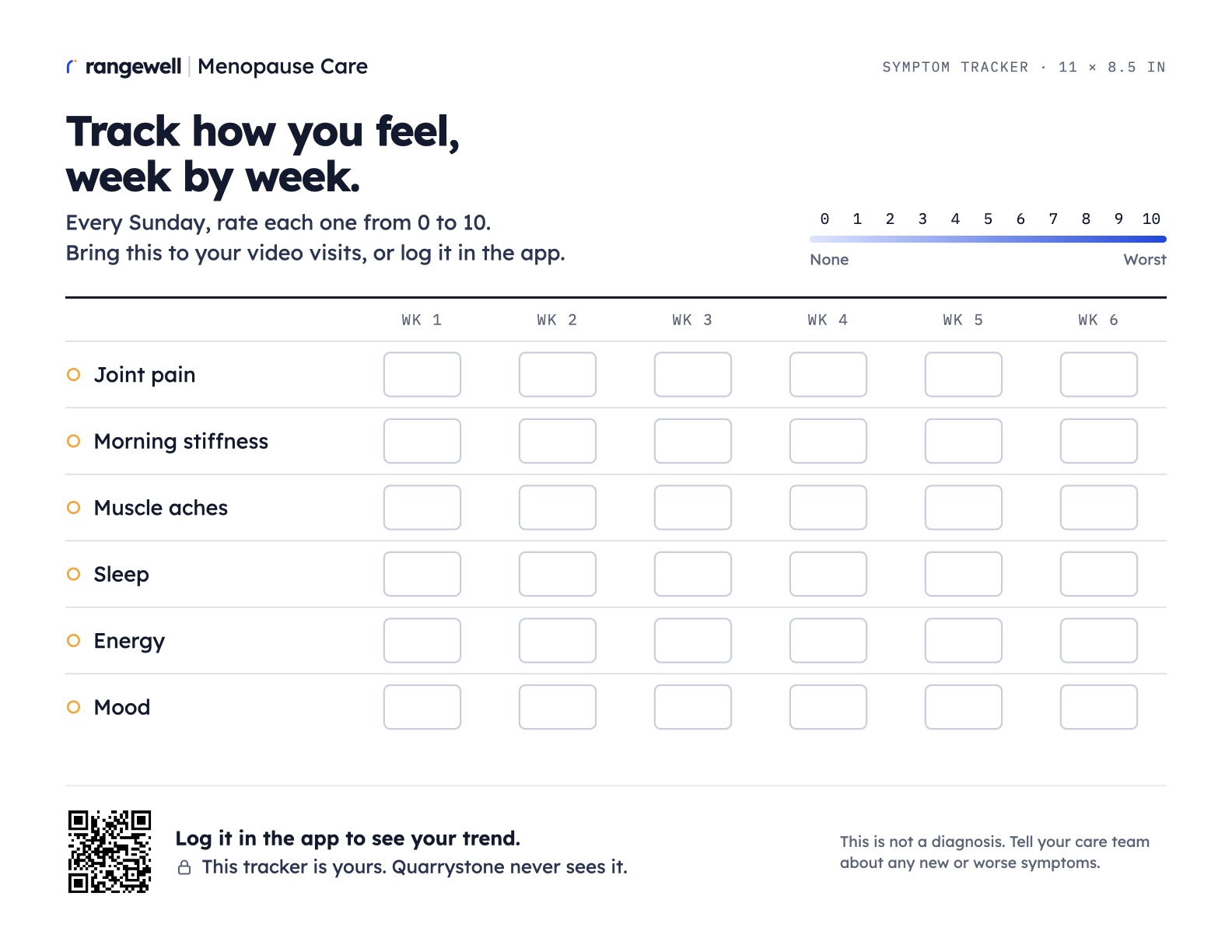
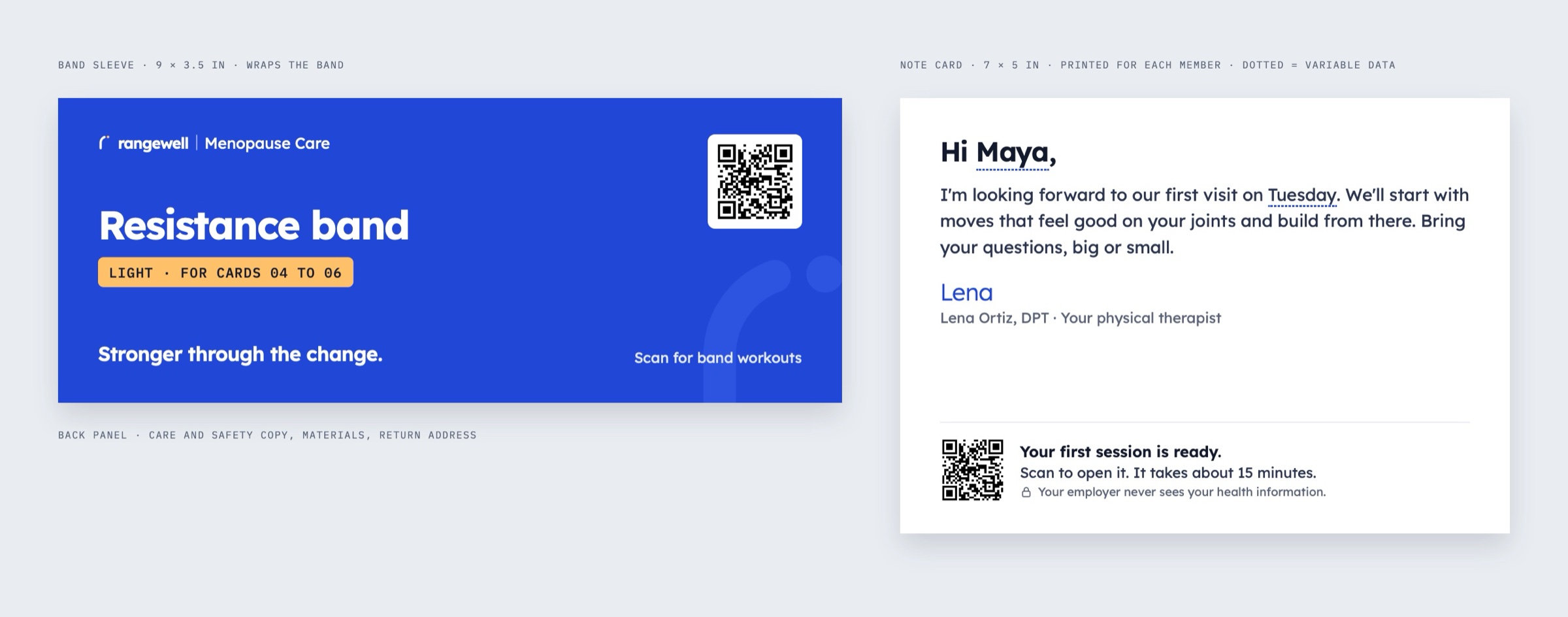
The box ships plain, with only the parent brand outside. Inside the lid she finds the program line and a QR code to her first session, then exercise cards that reuse the measured callouts, a six-week symptom tracker, a resistance band and a note from her physical therapist printed with her name and visit day.
The System Behind It
Design Systems · Brand Governance
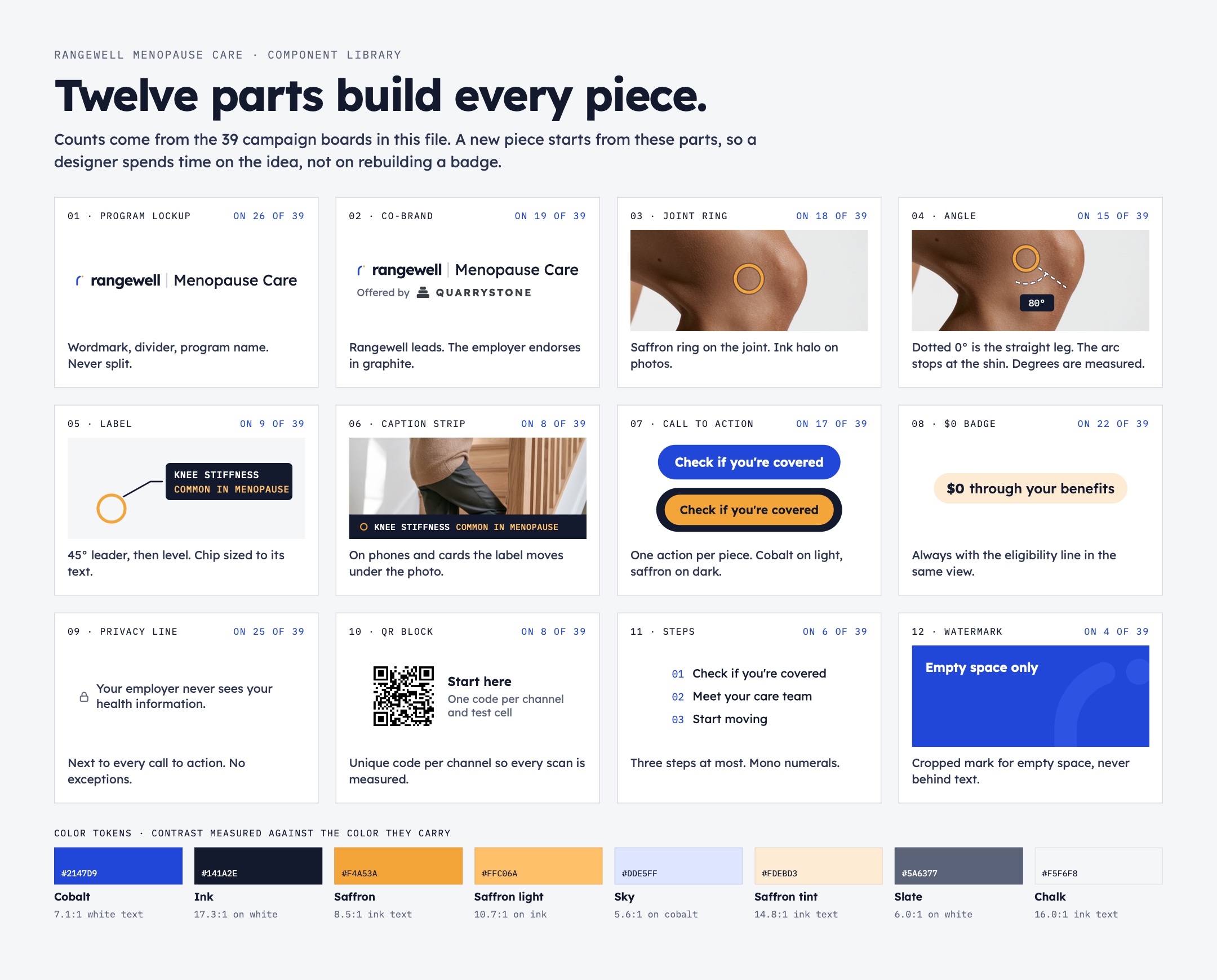
Twelve parts build every piece, and each one is counted across the 39 campaign boards, so the library shows what actually ships. Co-brand rules set three tiers: the employer leads what it sends, Rangewell leads what it sends, and discreet surfaces carry the parent brand only.
A variant matrix sizes every line for Spanish first, since support lines run up to 47% longer, and treats employers as tokens rather than new designs. A claims library ties every statement to a source, the channels it can run in and the line that must appear with it.
AI Production Loop
AI-Assisted Production · Art Direction
I built this piece with Figma, Adobe Creative Suite, generative AI tools including Midjourney, and Claude as a production partner, in a loop where machines measure and people decide. I generated the photography and made every creative call, pose detection measured the joints, and scripts placed the callouts from those coordinates. When the numbers and the eye disagreed, the eye won.
Measuring & Leading It
Experimentation · Creative Leadership
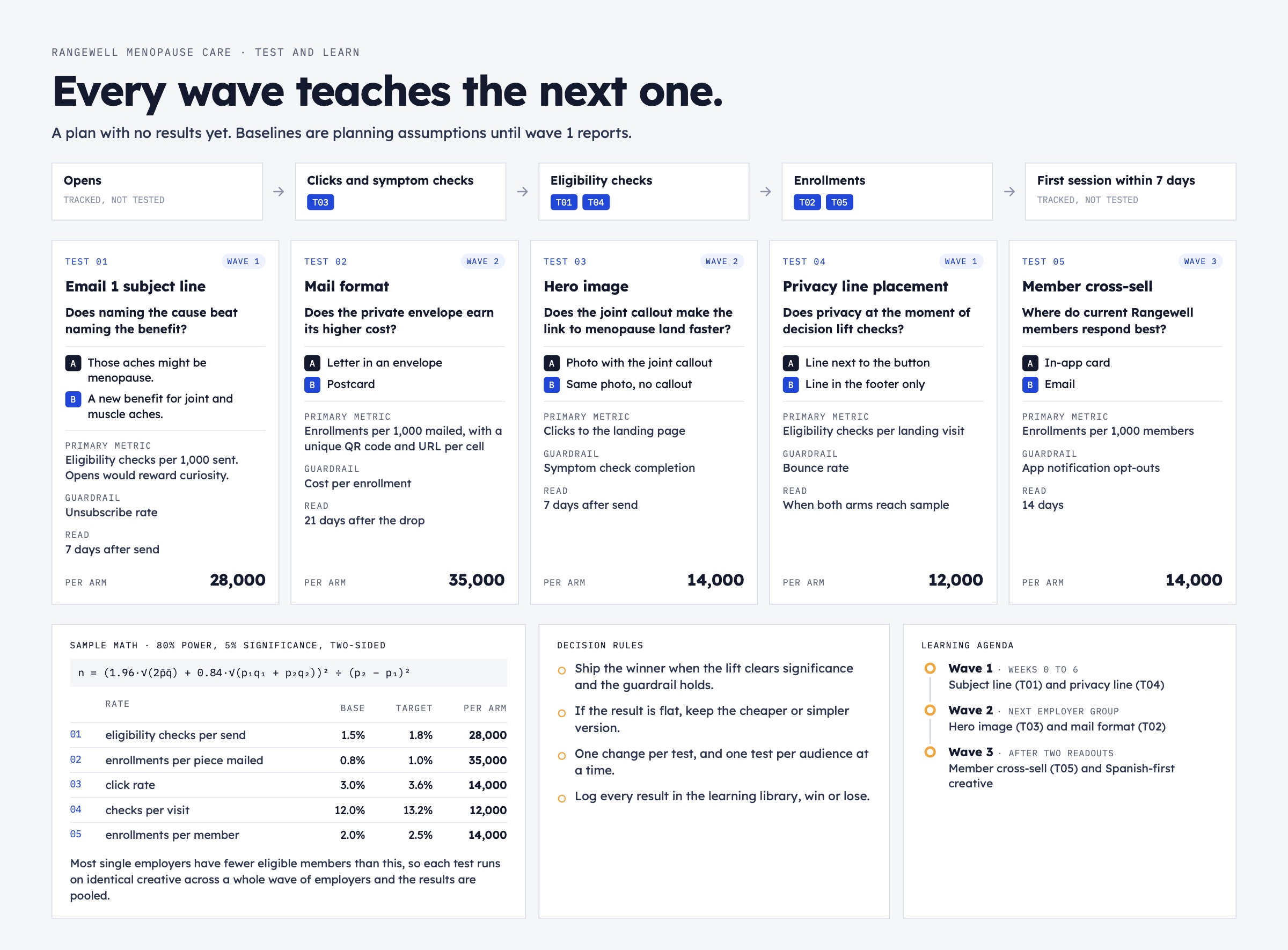
Five planned tests, each with a hypothesis, a primary metric, a guardrail and the sample size worked out per arm. Most single employers are too small to read a 20% lift, so each test runs on identical creative across a wave of employers.
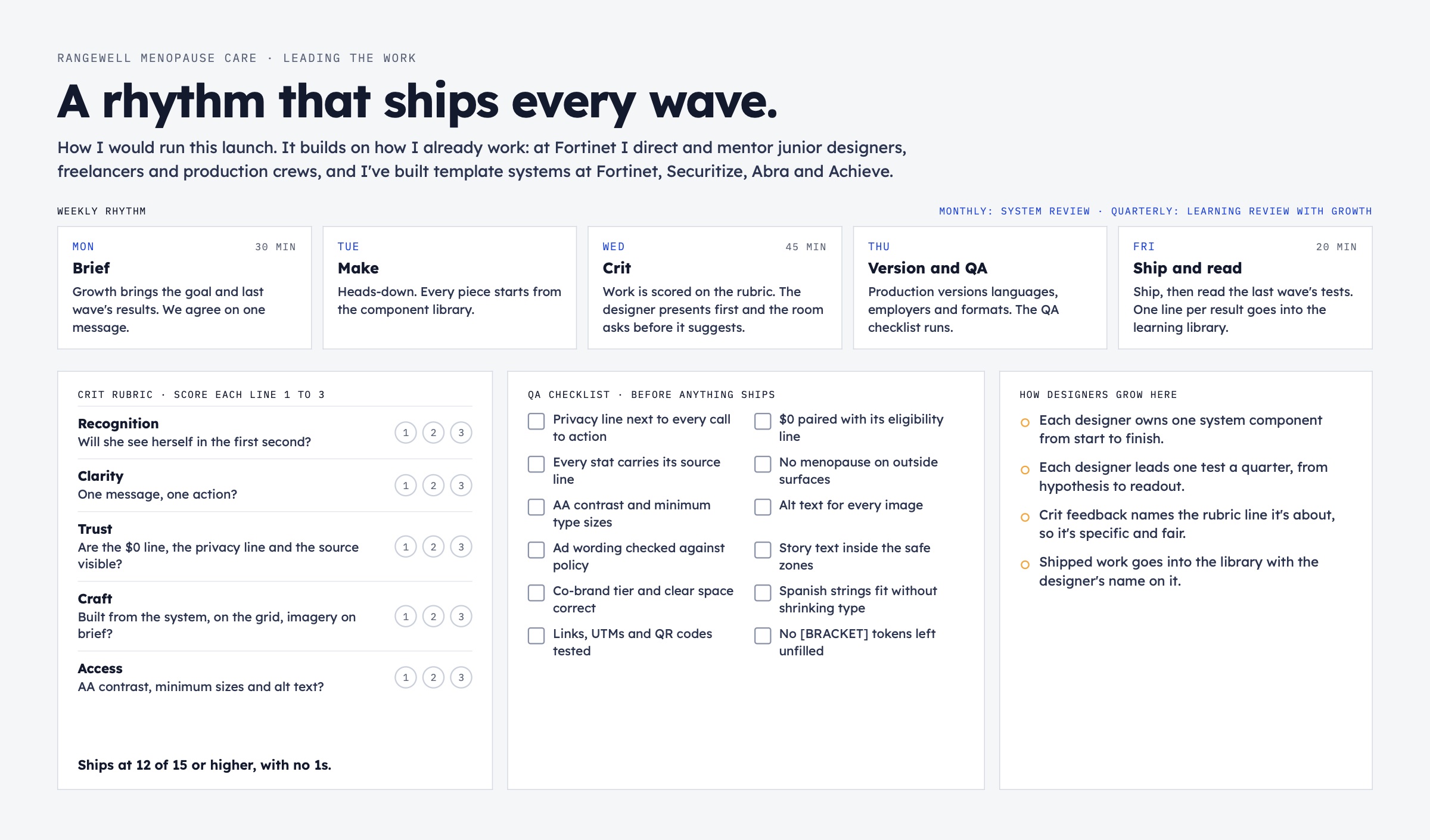
The leadership board shows how I would run it: a weekly rhythm from brief to ship, a five-line crit rubric and a QA checklist that checks what the system promises. It builds on how I work today, directing and mentoring designers, freelancers and production crews at Fortinet.